Statistical Analysis

Lab 12: DAGs

Bogdan G. Popescu

John Cabot University

Intro

Setup

Open a new Quarto document and use this preamble:

---
title: "Lab 12"
author: "Your Name"
date: today
format:
  html:
    toc: true
    number-sections: true
    colorlinks: true
    smooth-scroll: true
    embed-resources: true
---

Render and save under “week12” in your “stats” folder.

DAGs

What Are DAGs?

Directed Acyclic Graphs are theoretical models of how data is generated.

  • Directed: arrows point from cause to effect
  • Acyclic: no loops — causes flow in one direction
  • They tell you what to control for to isolate a causal effect
  • Build them at dagitty.net and replicate in R with ggdag + dagitty

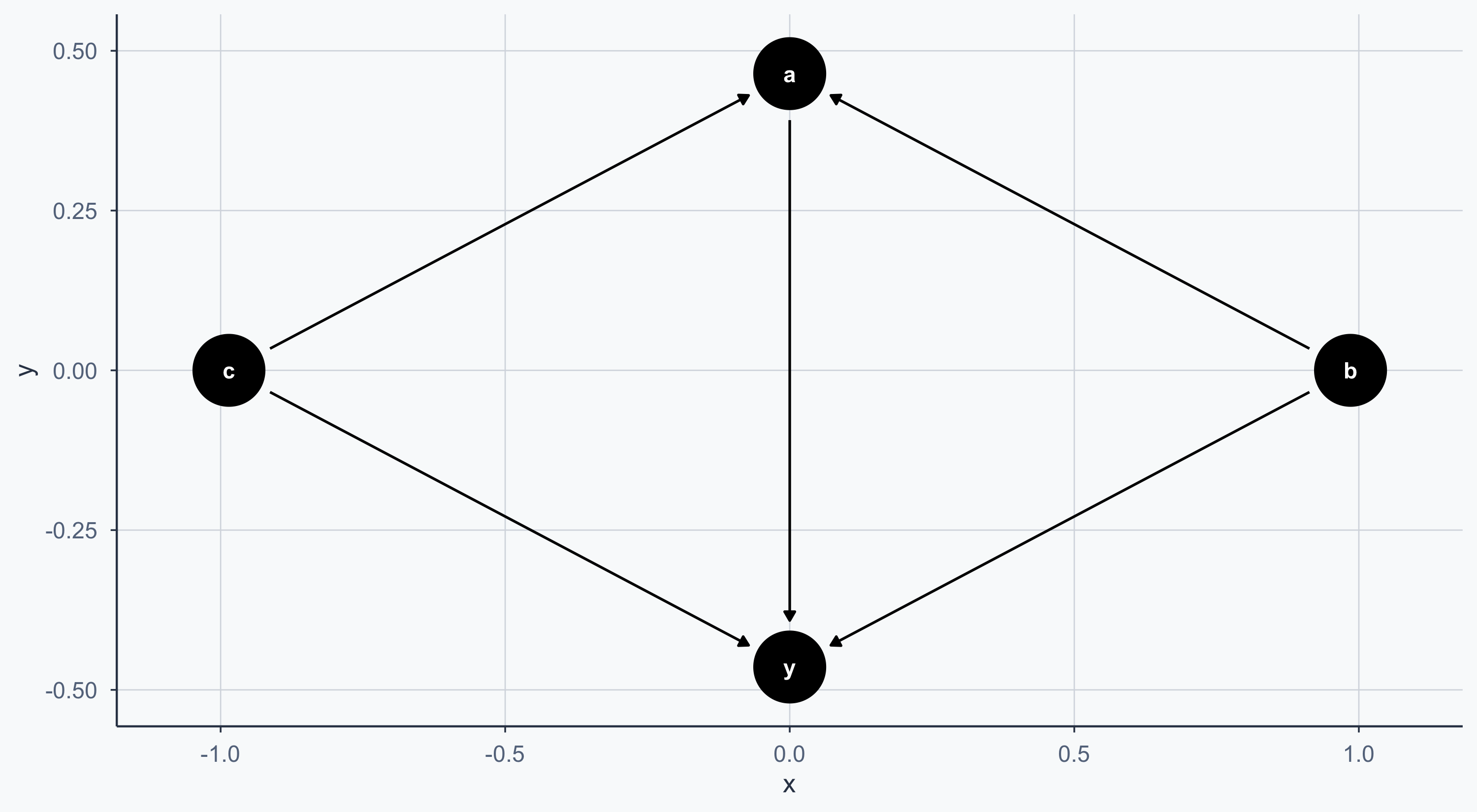
A Simple DAG

simple_dag <- dagify(
  y ~ a + b + c,
  a ~ b + c
)

ggdag(simple_dag) +
  theme_meridian()

Controlling the Layout

We can convert the DAG to a dataframe with tidy_dagitty for more control:
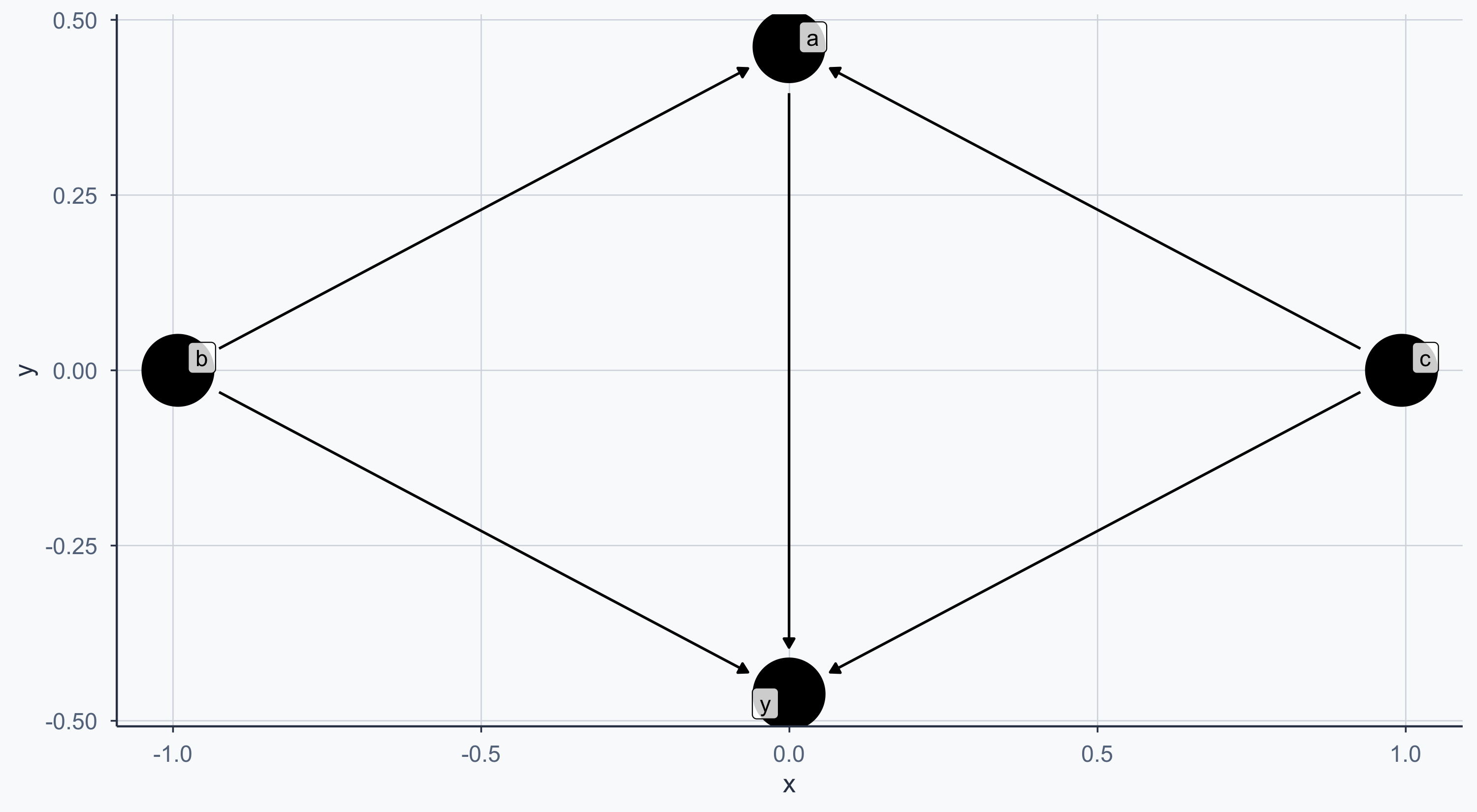
set.seed(1234)
bigger_dag <- data.frame(tidy_dagitty(simple_dag))

ggplot(bigger_dag, aes(x = x, y = y, xend = xend, yend = yend)) +
  geom_dag_point() +
  geom_dag_edges() +
  geom_label_repel(
    data = subset(bigger_dag, !duplicated(bigger_dag$name)),
    aes(label = name), fill = alpha("white", 0.8)
  ) +
  theme_meridian()

Controlling the Layout

We can convert the DAG to a dataframe with tidy_dagitty for more control:

Exposure and Outcome

We can mark the exposure (treatment) and outcome nodes:
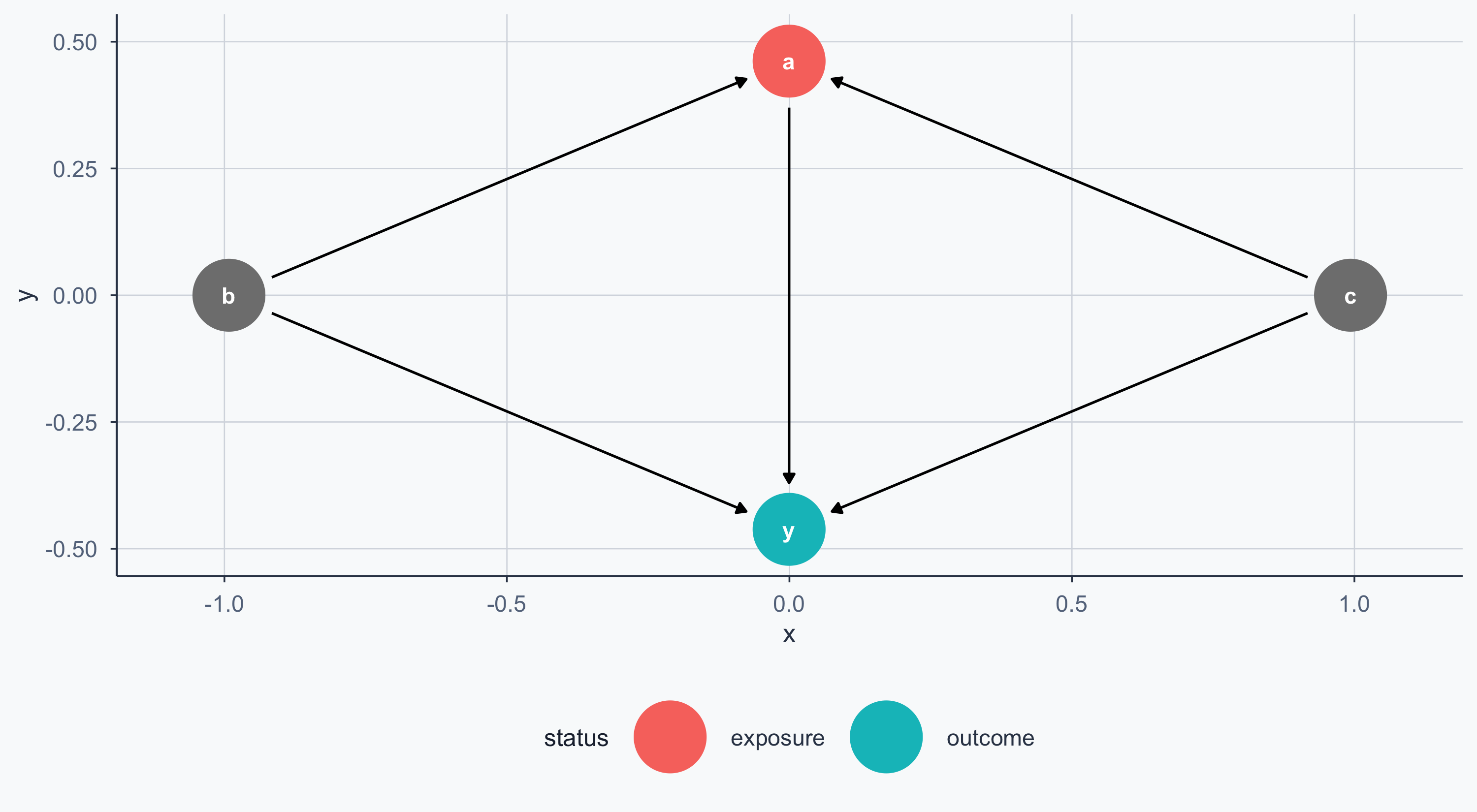
set.seed(1234)
simple_dag <- dagify(
  y ~ a + b + c,
  a ~ b + c,
  exposure = "a",
  outcome = "y"
)

ggdag_status(simple_dag) +
  theme_meridian()

Exposure and Outcome

We can mark the exposure (treatment) and outcome nodes:

Custom Labels
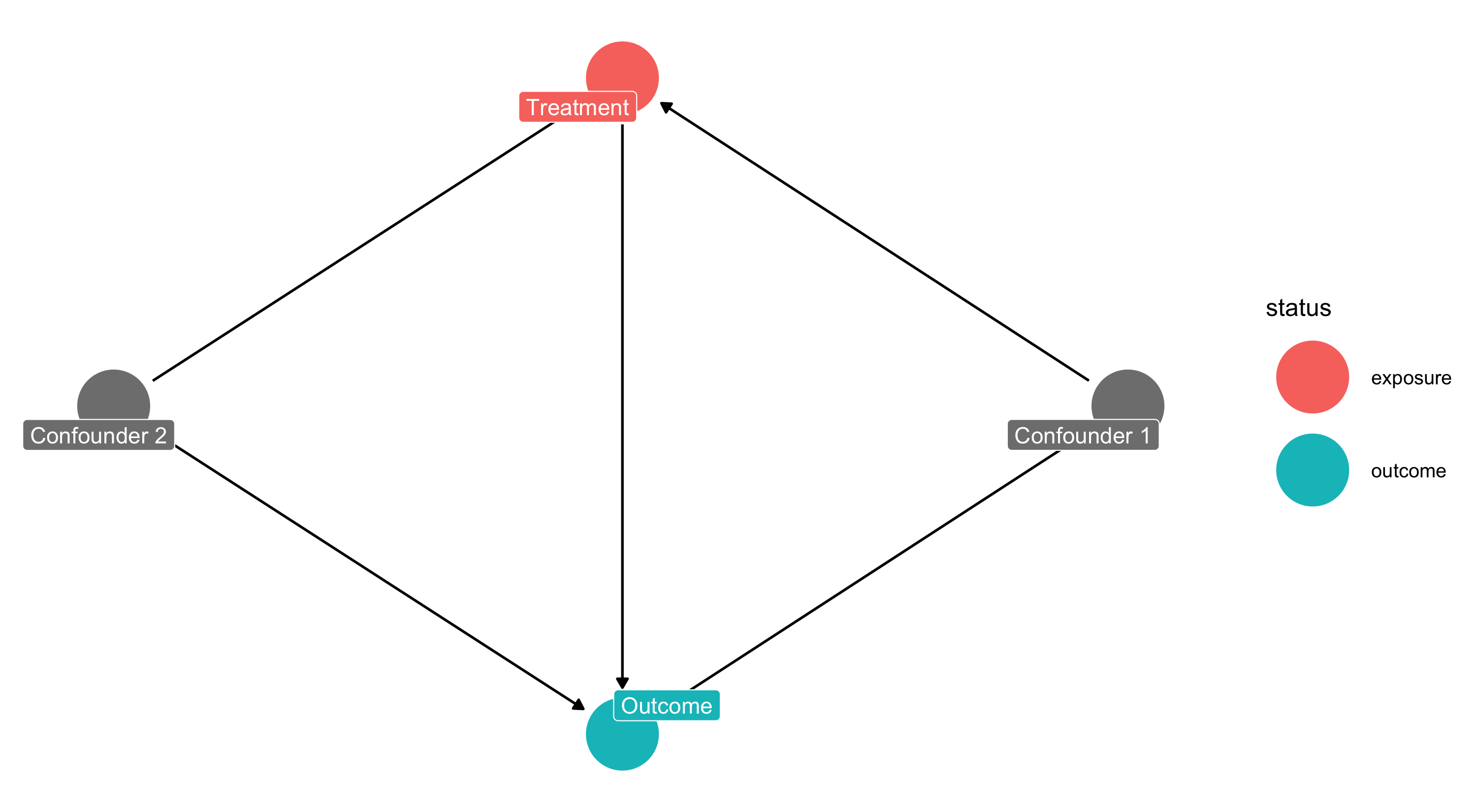
dag_with_var_names <- dagify(
  y ~ a + b + c,
  a ~ b + c,
  exposure = "a",
  outcome = "y",
  labels = c(y = "Outcome", a = "Treatment",
             b = "Confounder 1", c = "Confounder 2")
)

ggdag_status(dag_with_var_names,
             use_labels = "label", text = FALSE) +
  theme_dag()

Custom Labels

Importing from DAGitty

You can draw your DAG at dagitty.net and export the code directly into R:
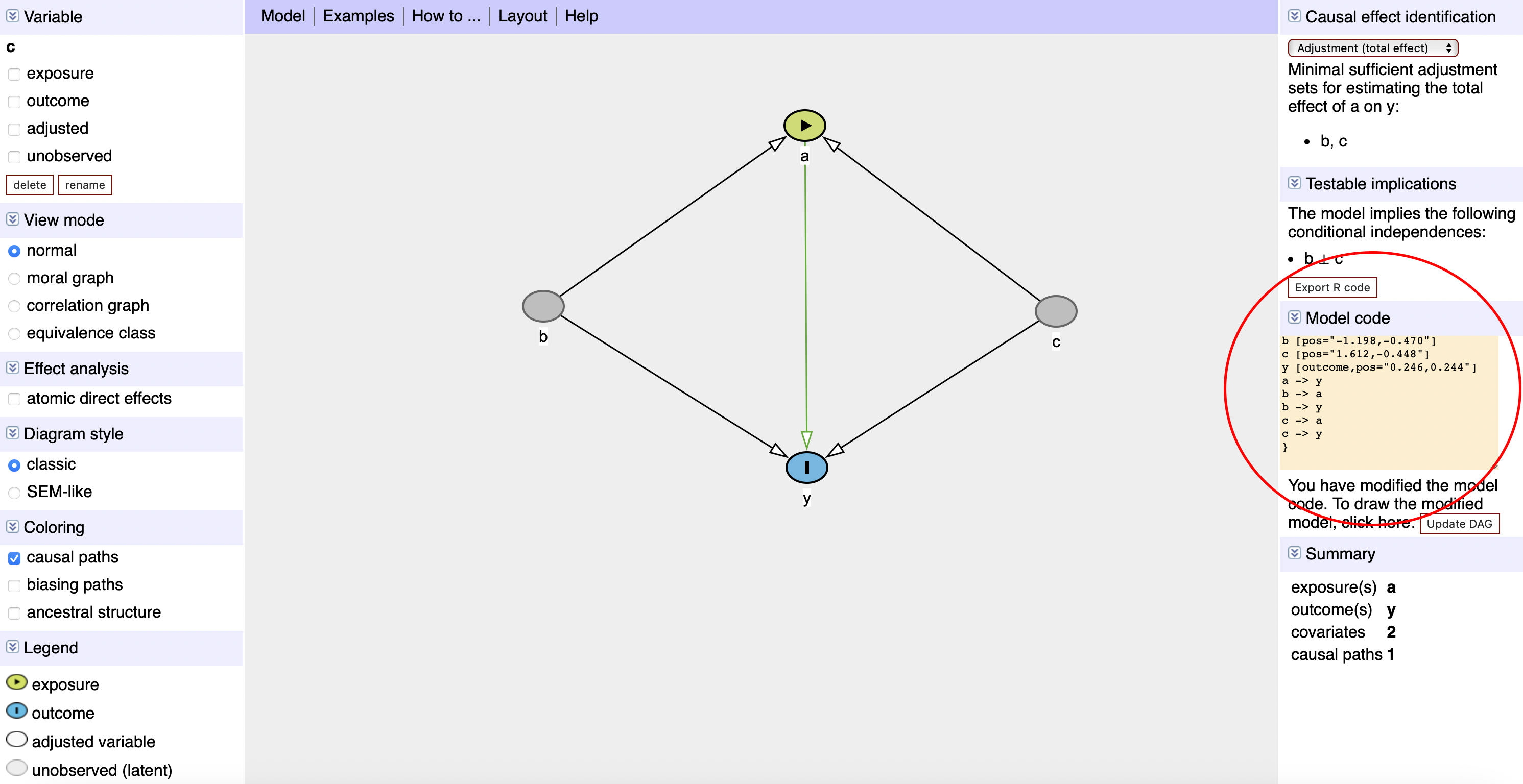
DAGitty Screenshot

DAGitty Code in R
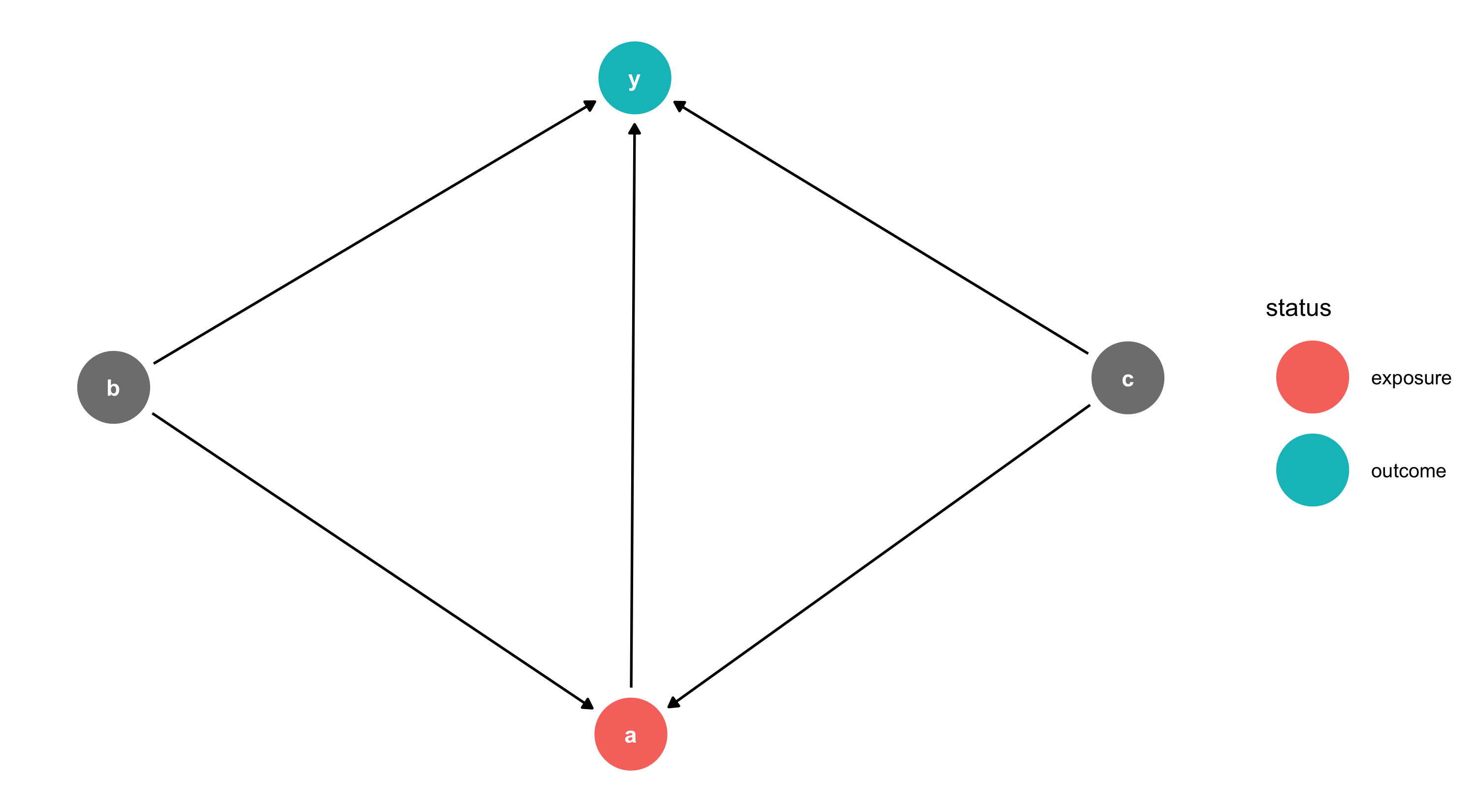
model_from_dagitty <- dagitty('dag {
bb="-2.821,-1.677,2.821,1.677"
a [exposure,pos="0.235,-1.270"]
b [pos="-1.198,-0.470"]
c [pos="1.612,-0.448"]
y [outcome,pos="0.246,0.244"]
a -> y
b -> a
b -> y
c -> a
c -> y
}')

ggdag_status(model_from_dagitty) +
  theme_dag()

DAGitty Code in R

Each node has X/Y coordinates — adjust them to change the layout.

The Malaria DAG

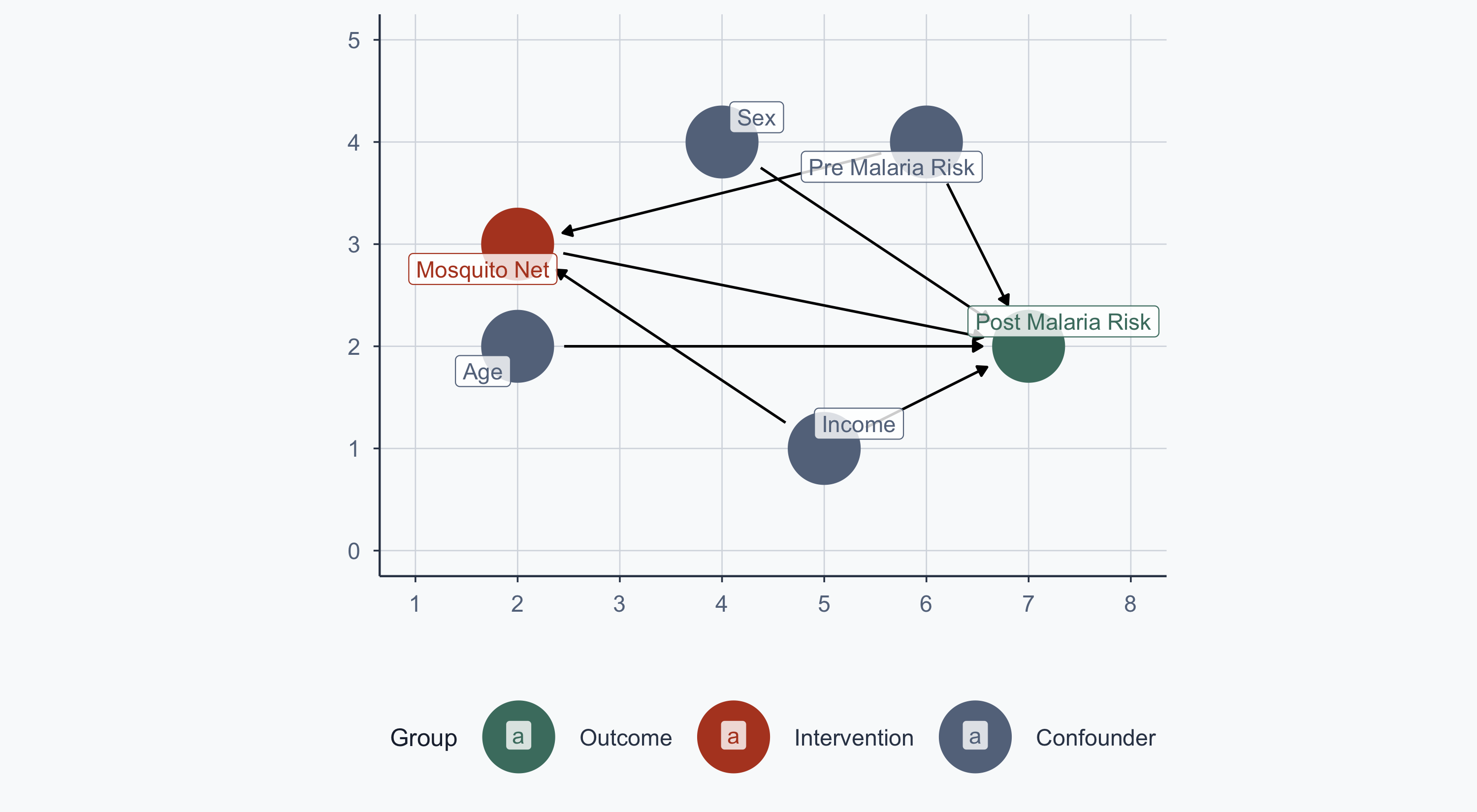
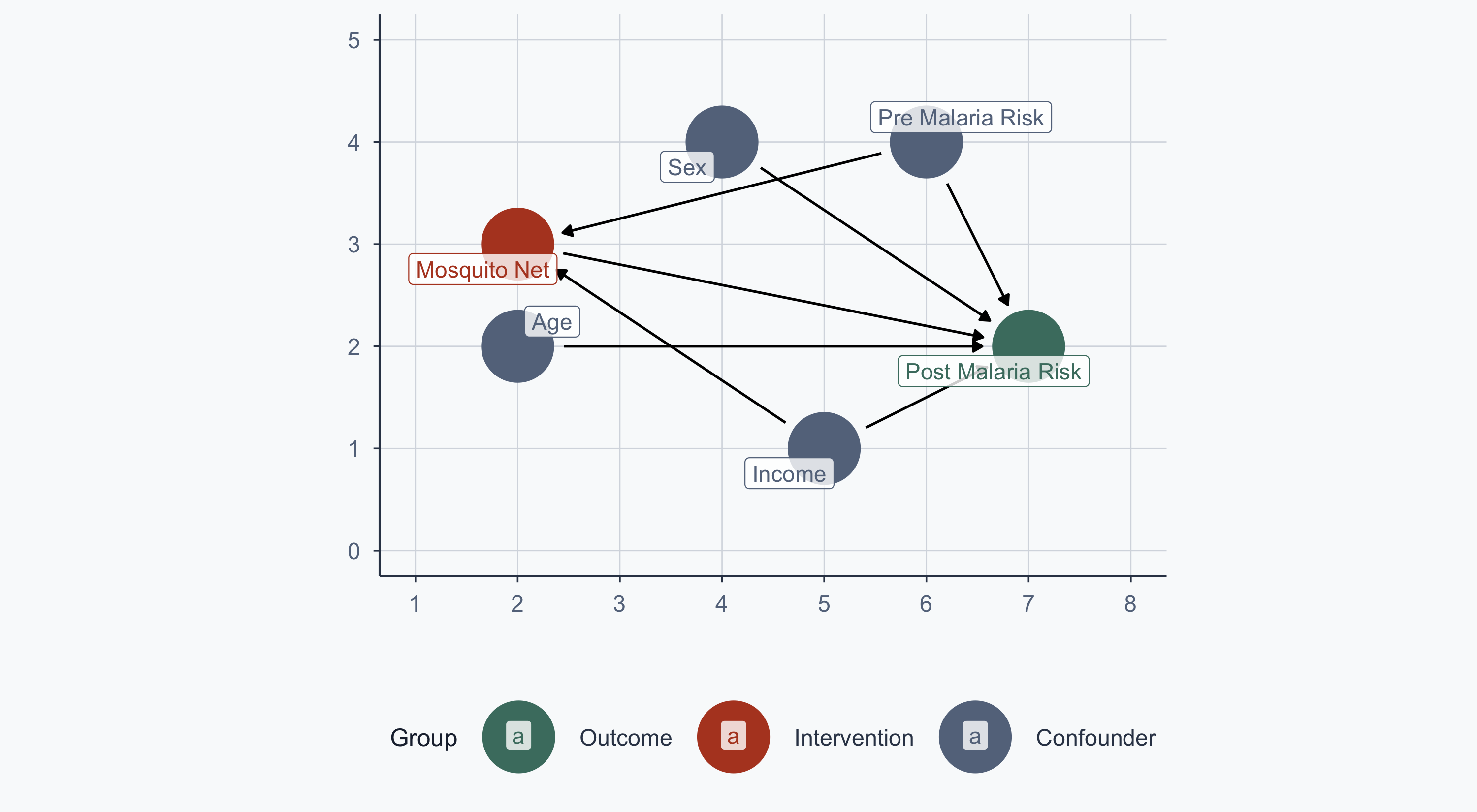
From Lab 11: malaria risk is determined by nets, age, sex, income, and pre-malaria risk. Net usage is determined by income and pre-malaria risk.

Show code
malaria_dag <- dagify(
  post_malaria_risk ~ net + age + sex + income + pre_malaria_risk,
  net ~ income + pre_malaria_risk,
  exposure = "net",
  outcome = "post_malaria_risk",
  labels = c(
    post_malaria_risk = "Post Malaria Risk",
    net = "Mosquito Net", age = "Age", sex = "Sex",
    income = "Income", pre_malaria_risk = "Pre Malaria Risk"
  ),
  coords = list(
    x = c(net = 2, post_malaria_risk = 7, income = 5,
          age = 2, sex = 4, pre_malaria_risk = 6),
    y = c(net = 3, post_malaria_risk = 2, income = 1,
          age = 2, sex = 4, pre_malaria_risk = 4)
  )
)

bigger_dag <- data.frame(tidy_dagitty(malaria_dag))
bigger_dag$type <- "Confounder"
bigger_dag$type[bigger_dag$name == "post_malaria_risk"] <- "Outcome"
bigger_dag$type[bigger_dag$name == "net"] <- "Intervention"

min_x <- min(bigger_dag$x); max_x <- max(bigger_dag$x)
min_y <- min(bigger_dag$y); max_y <- max(bigger_dag$y)

col <- c("Outcome" = sage, "Intervention" = terracotta, "Confounder" = stone)
order_col <- c("Outcome", "Intervention", "Confounder")

ggplot(bigger_dag, aes(x = x, y = y, xend = xend, yend = yend, color = type)) +
  geom_dag_point() +
  geom_dag_edges() +
  coord_sf(xlim = c(min_x - 1, max_x + 1), ylim = c(min_y - 1, max_y + 1)) +
  scale_colour_manual(values = col, name = "Group", breaks = order_col) +
  geom_label_repel(
    data = subset(bigger_dag, !duplicated(bigger_dag$label)),
    aes(label = label), fill = alpha("white", 0.8)
  ) +
  labs(x = "", y = "") +
  theme_meridian()
Matching

From RCT to Observational Data

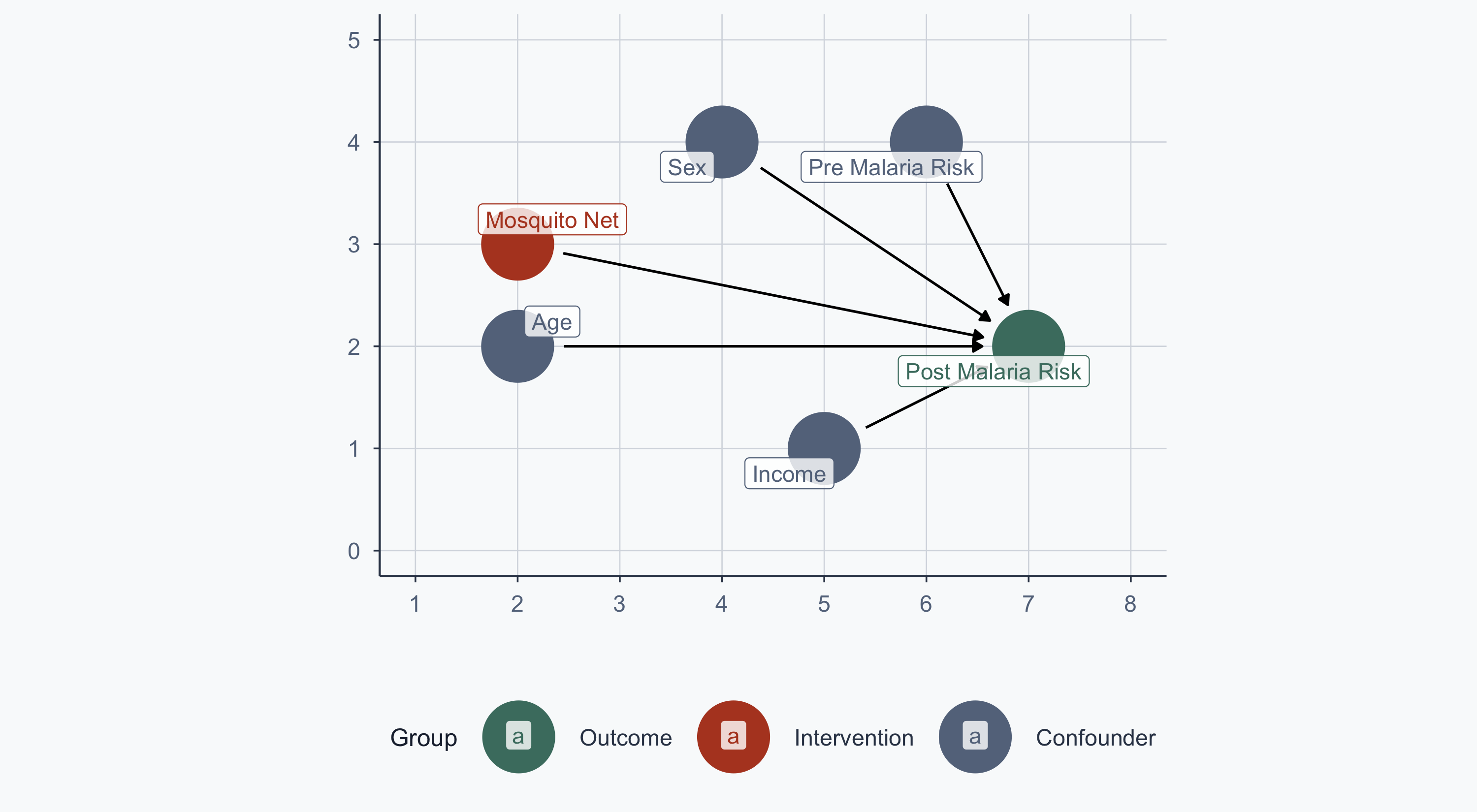
In Lab 11, treatment was randomized — no arrows into the net node:

Show code
malaria_dag2 <- dagify(
  post_malaria_risk ~ net + age + sex + income + pre_malaria_risk,
  exposure = "net",
  outcome = "post_malaria_risk",
  labels = c(
    post_malaria_risk = "Post Malaria Risk",
    net = "Mosquito Net", age = "Age", sex = "Sex",
    income = "Income", pre_malaria_risk = "Pre Malaria Risk"
  ),
  coords = list(
    x = c(net = 2, post_malaria_risk = 7, income = 5,
          age = 2, sex = 4, pre_malaria_risk = 6),
    y = c(net = 3, post_malaria_risk = 2, income = 1,
          age = 2, sex = 4, pre_malaria_risk = 4)
  )
)

bigger_dag2 <- data.frame(tidy_dagitty(malaria_dag2))
bigger_dag2$type <- "Confounder"
bigger_dag2$type[bigger_dag2$name == "post_malaria_risk"] <- "Outcome"
bigger_dag2$type[bigger_dag2$name == "net"] <- "Intervention"

ggplot(bigger_dag2, aes(x = x, y = y, xend = xend, yend = yend, color = type)) +
  geom_dag_point() +
  geom_dag_edges() +
  coord_sf(xlim = c(min_x - 1, max_x + 1), ylim = c(min_y - 1, max_y + 1)) +
  scale_colour_manual(values = col, name = "Group", breaks = order_col) +
  geom_label_repel(
    data = subset(bigger_dag2, !duplicated(bigger_dag2$label)),
    aes(label = label), fill = alpha("white", 0.8)
  ) +
  labs(x = "", y = "") +
  theme_meridian()
The Observational Problem

Now assume people choose whether to use a net. The confounding arrows return:

Show code
ggplot(bigger_dag, aes(x = x, y = y, xend = xend, yend = yend, color = type)) +
  geom_dag_point() +
  geom_dag_edges() +
  coord_sf(xlim = c(min_x - 1, max_x + 1), ylim = c(min_y - 1, max_y + 1)) +
  scale_colour_manual(values = col, name = "Group", breaks = order_col) +
  geom_label_repel(
    data = subset(bigger_dag, !duplicated(bigger_dag$label)),
    aes(label = label), fill = alpha("white", 0.8)
  ) +
  labs(x = "", y = "") +
  theme_meridian()
We want to estimate: \(\text{Malaria Risk} = \beta_0 + \beta_1 \text{Income} + \beta_2 \text{Treatment}\)

Loading the Data

rct_data <- read.csv(file = './data/rct_data_geo_malawi.csv')
glimpse(rct_data, n = 10)
Rows: 1,000
Columns: 10
$ id                <int> 1, 2, 3, 4, 5, 6, 7, 8, 9, 10, 11, 12, 13, 14, 15, 1…
$ lat               <dbl> -11.27476, -11.15300, -11.13967, -11.25544, -11.1777…
$ lon               <dbl> 34.03006, 34.14594, 34.14297, 34.14619, 34.20031, 34…
$ income            <dbl> 409.4701, 520.8072, 581.3331, 324.0727, 532.1844, 53…
$ age               <int> 10, 35, 7, 43, 45, 51, 24, 17, 38, 69, 10, 21, 32, 3…
$ sex               <chr> "Man", "Woman", "Woman", "Woman", "Man", "Woman", "M…
$ health            <dbl> 82.78928, 81.18602, 80.57399, 82.84023, 87.40737, 57…
$ net               <int> 0, 1, 0, 0, 1, 1, 1, 0, 1, 1, 1, 1, 1, 1, 0, 0, 0, 1…
$ malaria_risk_pre  <dbl> 35.74454, 36.65260, 22.87415, 35.41934, 27.49873, 42…
$ malaria_risk_post <dbl> 42.52199, 34.27589, 32.67552, 43.87256, 27.16945, 41…

Download: Intervention Data

Regression with Confounders

m1 <- lm(malaria_risk_post ~ income + net, data = rct_data)
modelsummary(m1, stars = TRUE, gof_map = c("nobs", "r.squared"))
(1)
+ p < 0.1, * p < 0.05, ** p < 0.01, *** p < 0.001
(Intercept) 68.138***
(1.816)
income -0.045***
(0.004)
net -10.125***
(0.533)
Num.Obs. 1000
R2 0.342
  • For every unit increase in income, malaria risk decreases by ~0.045 units, holding net use constant
  • People who use nets have ~10.1 units lower malaria risk, holding income constant

Why Not Just Control with OLS?

The regression above controls for income — so why do we need matching at all?

  • OLS assumes a linear, additive relationship — if the functional form is wrong, the estimate is biased
  • OLS extrapolates — it estimates treatment effects even where treated and control groups don’t overlap in confounder space
  • Matching forces you to compare only comparable units, avoiding extrapolation entirely

Matching makes the comparison explicit; regression hides it in functional form assumptions.

Scatterplot: Pooled Regression Line

Show code
rct_data$type <- "Control\n Don't Use Nets"
rct_data$type[rct_data$net == 1] <- "Treatment\n Use Nets"

cols <- c("Control\n Don't Use Nets" = graphite,
          "Treatment\n Use Nets" = terracotta)

x <- lm(malaria_risk_post ~ income, data = rct_data)
a <- x$coefficients[1]
b <- x$coefficients[2]

ggplot(rct_data, aes(x = income, y = malaria_risk_post, group = type)) +
  geom_point(aes(shape = type, color = type), size = 2, alpha = 0.6) +
  scale_shape_manual(name = "", values = c(16, 17)) +
  scale_color_manual(name = "", values = cols) +
  geom_segment(aes(x = min(income), y = a,
                   xend = max(income), yend = b * max(income) + a),
               color = slate, linewidth = 0.8) +
  scale_x_continuous(name = "Income") +
  scale_y_continuous(name = "Malaria Risk") +
  theme_meridian() +
  theme(legend.position = c(0.15, 0.15))
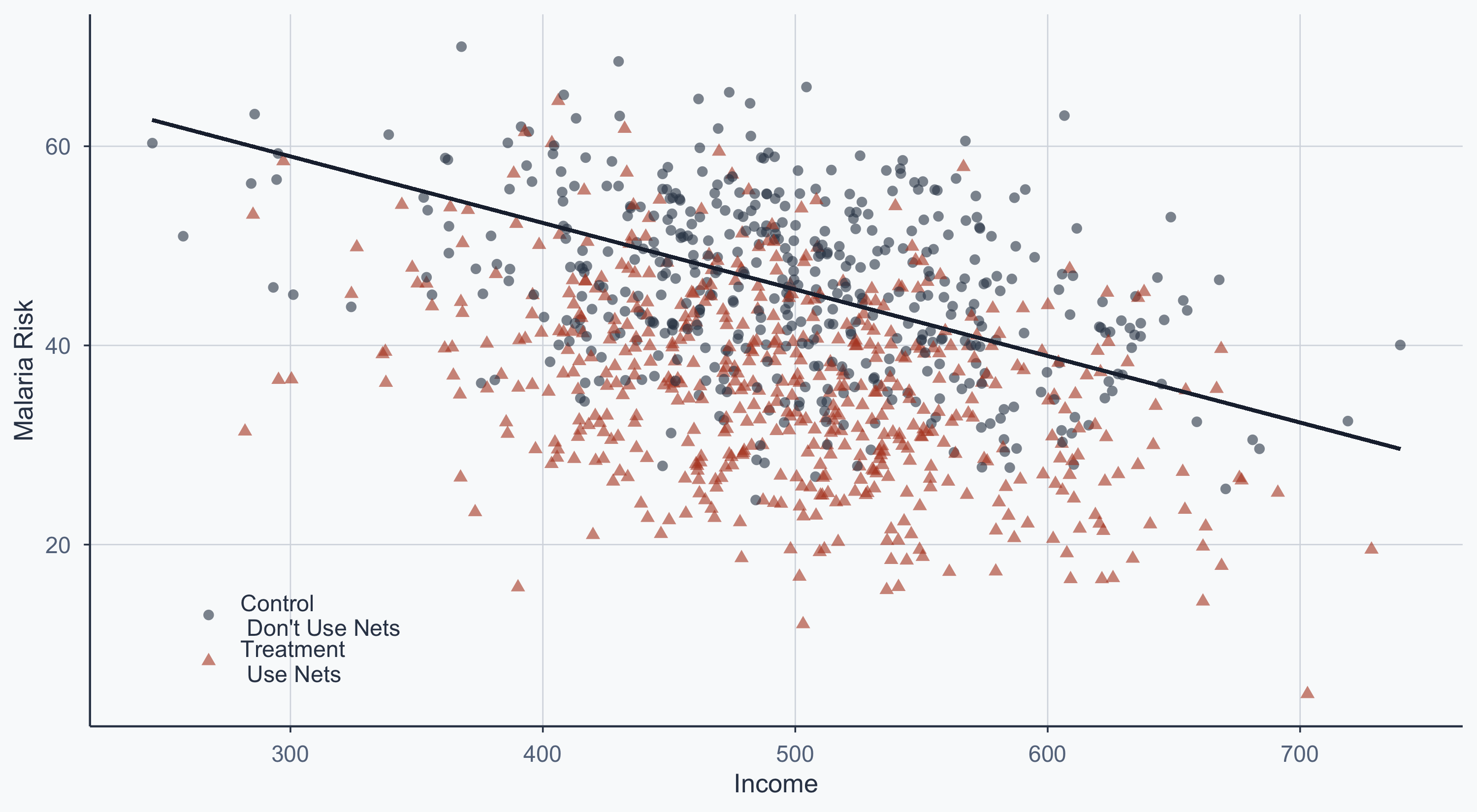
Pooled Regression Summary

modelsummary(x, stars = TRUE, gof_map = c("nobs", "r.squared"))
(1)
+ p < 0.1, * p < 0.05, ** p < 0.01, *** p < 0.001
(Intercept) 62.641***
(2.091)
income -0.045***
(0.004)
Num.Obs. 1000
R2 0.104

Scatterplot: Separate Group Lines

Show code
x1 <- lm(malaria_risk_post ~ income, data = subset(rct_data, net == 0))
a1 <- x1$coefficients[1]
b1 <- x1$coefficients[2]

x2 <- lm(malaria_risk_post ~ income, data = subset(rct_data, net == 1))
a2 <- x2$coefficients[1]
b2 <- x2$coefficients[2]

ggplot(rct_data, aes(x = income, y = malaria_risk_post, group = type)) +
  geom_point(aes(shape = type, color = type), size = 2, alpha = 0.6) +
  scale_shape_manual(name = "", values = c(16, 17)) +
  scale_color_manual(name = "", values = cols) +
  geom_segment(aes(x = min(income), y = a1,
                   xend = max(income), yend = b1 * max(income) + a1),
               color = graphite, linewidth = 0.8) +
  geom_segment(aes(x = min(income), y = a2,
                   xend = max(income), yend = b2 * max(income) + a2),
               color = terracotta, linewidth = 0.8) +
  scale_x_continuous(name = "Income") +
  scale_y_continuous(name = "Malaria Risk") +
  theme_meridian() +
  theme(legend.position = c(0.15, 0.15))
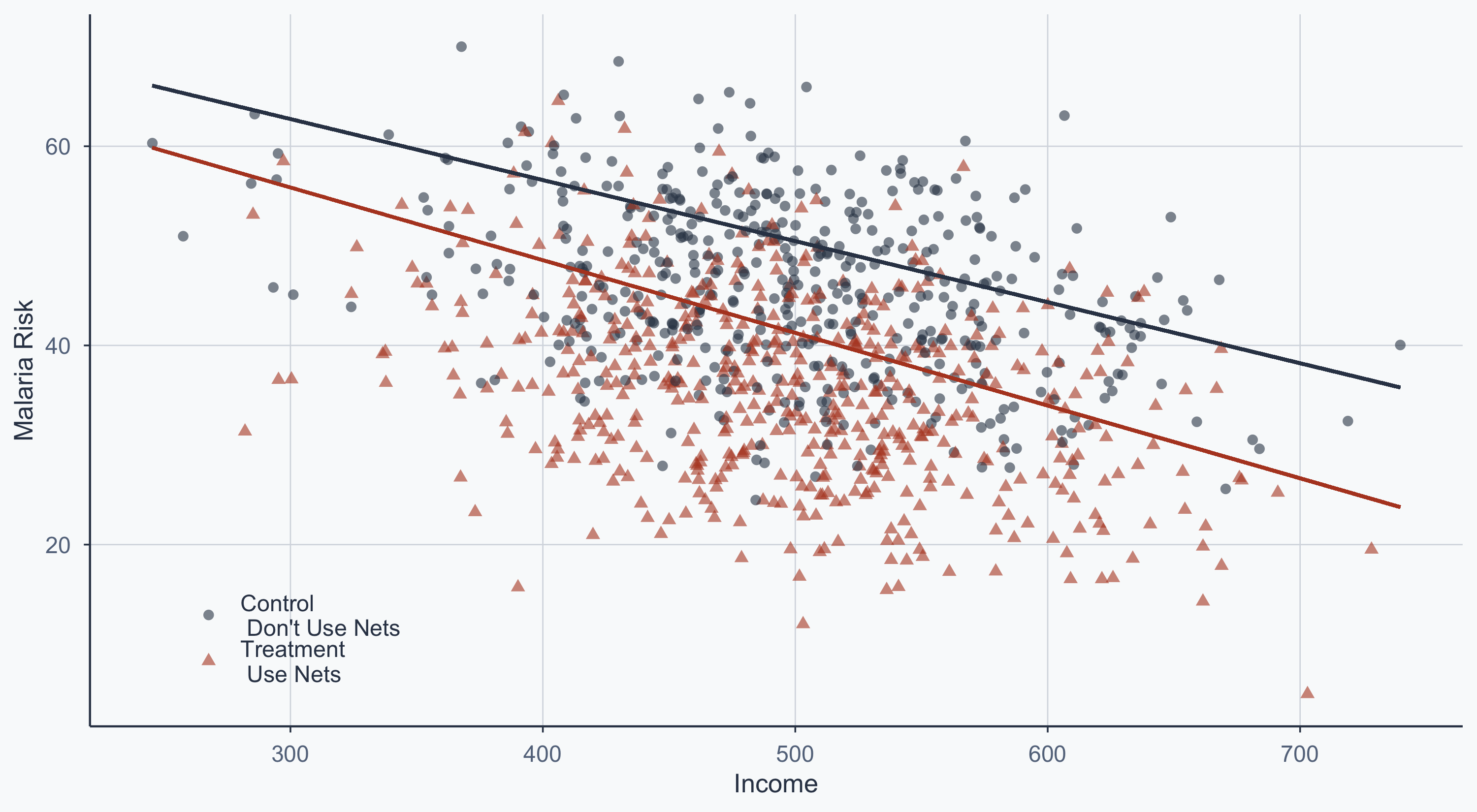
The vertical gap between the two lines is the treatment effect, conditional on income.

Matching: Mahalanobis Distance

Why Matching?

In observational data, treatment and control groups differ systematically on confounders.

  • People who choose nets tend to have higher income and higher pre-malaria risk
  • A naive comparison conflates the net’s effect with these pre-existing differences
  • Matching finds comparable pairs: similar on confounders, but differing in treatment

Nearest Neighbor Matching

We use MatchIt to match on income and pre-malaria risk using Mahalanobis distance:

matched_ob <- matchit(
  net ~ income + malaria_risk_pre,
  data = rct_data,
  method = "nearest",
  distance = "mahalanobis",
  replace = FALSE
)
matched_ob
A `matchit` object
 - method: 1:1 nearest neighbor matching without replacement
 - distance: Mahalanobis - number of obs.: 1000 (original), 956 (matched)
 - target estimand: ATT
 - covariates: income, malaria_risk_pre

Which Observations Were Dropped?

matched <- match.data(matched_ob)
matched$type_match <- "Kept"
matched_mer <- subset(matched, select = c(id, type_match))

rct2 <- left_join(rct_data, matched_mer, by = "id")
rct2$type_match[is.na(rct2$type_match)] <- "Dropped"
rct2$type_match_fin <- rct2$type
rct2$type_match_fin[rct2$type_match == "Dropped"] <- "Dropped"

fixed <- subset(rct2, type_match_fin != "Dropped")
fixed_dropped <- subset(rct2, type_match_fin == "Dropped")
head(fixed_dropped, n=5)
     id       lat      lon   income age   sex   health net malaria_risk_pre
922 922 -11.27303 34.06292 469.1548  30   Man 46.65226   1         50.72628
923 923 -11.15976 34.15160 528.6761  29   Man 68.75519   1         43.87560
930 930 -11.18827 34.02909 442.4063  24 Woman 69.66138   1         44.33456
931 931 -11.21571 34.20041 485.5473  27 Woman 52.71393   1         57.68744
932 932 -11.17675 34.08594 571.9288  50   Man 62.96108   1         45.10550
    malaria_risk_post                 type type_match type_match_fin
922          48.49282 Treatment\n Use Nets    Dropped        Dropped
923          41.93094 Treatment\n Use Nets    Dropped        Dropped
930          39.94100 Treatment\n Use Nets    Dropped        Dropped
931          49.89029 Treatment\n Use Nets    Dropped        Dropped
932          41.00261 Treatment\n Use Nets    Dropped        Dropped

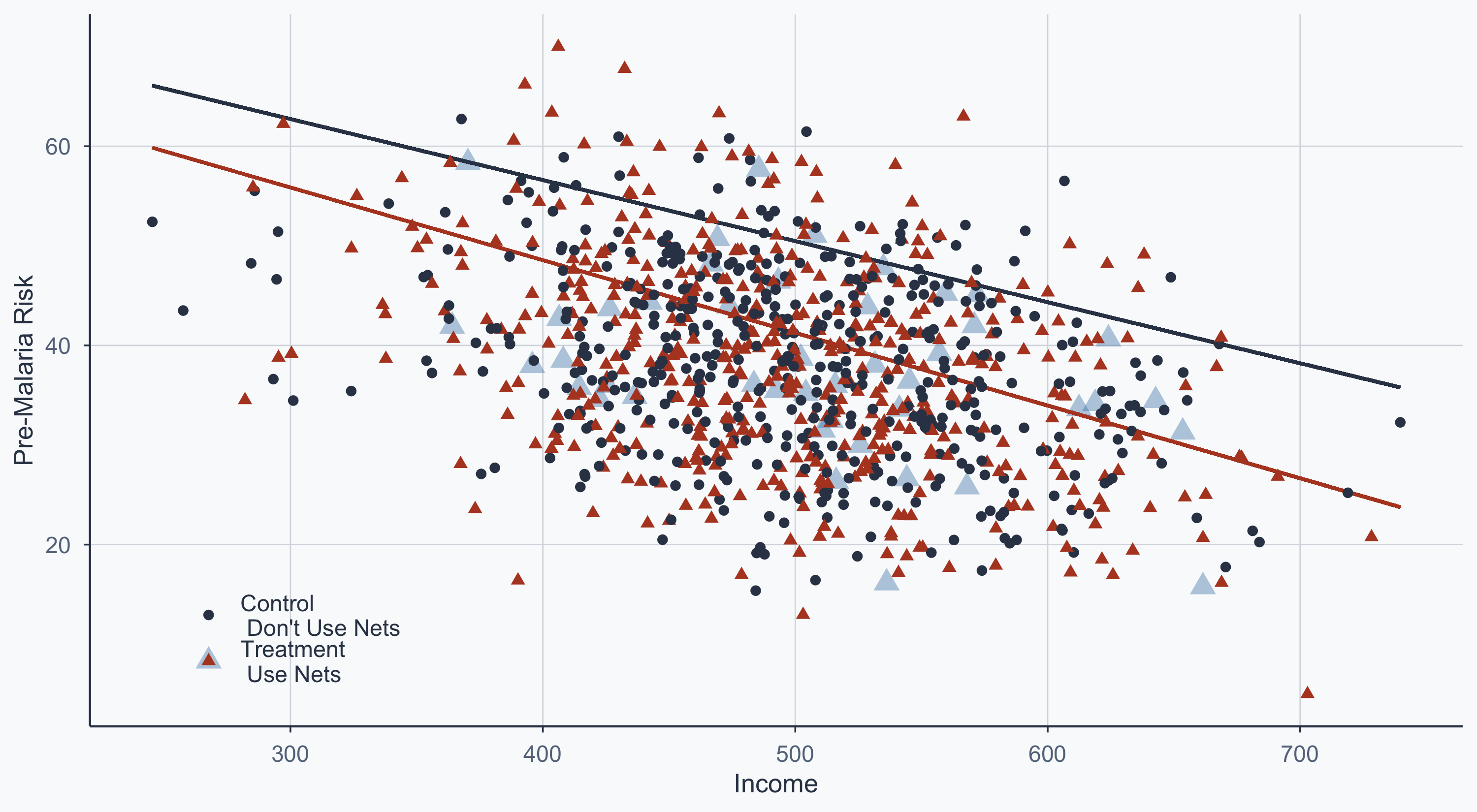
Matched Scatterplot

Blue points = dropped by matching. The remaining points are comparable pairs.

Show code
ggplot(rct2, aes(x = income, y = malaria_risk_pre, group = type_match_fin)) +
  geom_point(data = fixed_dropped, aes(shape = type),
             color = "steelblue", size = 4, alpha = 0.4) +
  geom_segment(aes(x = min(income), y = a1,
                   xend = max(income), yend = b1 * max(income) + a1),
               color = graphite, linewidth = 0.8) +
  geom_segment(aes(x = min(income), y = a2,
                   xend = max(income), yend = b2 * max(income) + a2),
               color = terracotta, linewidth = 0.8) +
  geom_point(data = fixed, aes(shape = type_match_fin, color = type_match_fin),
             size = 2) +
  scale_shape_manual(name = "", values = c(16, 17)) +
  scale_color_manual(name = "", values = cols) +
  scale_x_continuous(name = "Income") +
  scale_y_continuous(name = "Pre-Malaria Risk") +
  theme_meridian() +
  theme(legend.position = c(0.15, 0.15))
Did Matching Improve Balance?

Show code
bal <- summary(matched_ob)

bal_before <- data.frame(
  Variable = rownames(bal$sum.all),
  `Mean Treated` = round(bal$sum.all[, "Means Treated"], 2),
  `Mean Control` = round(bal$sum.all[, "Means Control"], 2),
  `Std. Mean Diff.` = round(bal$sum.all[, "Std. Mean Diff."], 4),
  check.names = FALSE
)

bal_after <- data.frame(
  Variable = rownames(bal$sum.matched),
  `Mean Treated` = round(bal$sum.matched[, "Means Treated"], 2),
  `Mean Control` = round(bal$sum.matched[, "Means Control"], 2),
  `Std. Mean Diff.` = round(bal$sum.matched[, "Std. Mean Diff."], 4),
  check.names = FALSE
)

knitr::kable(bal_before,
  caption = "Before Matching: Mean confounder values for treated vs. control (all observations)",
  row.names = FALSE) |>
  kableExtra::kable_styling(font_size = 18, full_width = FALSE)
Before Matching: Mean confounder values for treated vs. control (all observations)
Variable Mean Treated Mean Control Std. Mean Diff.
income 497.56 498.50 -0.0125
malaria_risk_pre 37.96 37.97 -0.0010
Show code
knitr::kable(bal_after,
  caption = "After Matching: Mean confounder values for treated vs. control (matched pairs only)",
  row.names = FALSE) |>
  kableExtra::kable_styling(font_size = 18, full_width = FALSE)
After Matching: Mean confounder values for treated vs. control (matched pairs only)
Variable Mean Treated Mean Control Std. Mean Diff.
income 496.54 498.50 -0.0260
malaria_risk_pre 37.94 37.97 -0.0026
  • Std. Mean Differences are already near zero before matching — this data comes from an RCT
  • Matching on already-balanced data doesn’t improve balance
  • In truly observational data, you would expect mean differences to shrink substantially after matching

Naive vs. Matched Regression

x1 <- lm(malaria_risk_post ~ net, data = rct_data)
x2 <- lm(malaria_risk_post ~ net, data = matched)

models <- list("Naive Regression" = x1,
               "Matched" = x2)
modelsummary(models, stars = TRUE, gof_map = c("nobs", "r.squared"))
Naive Regression Matched
+ p < 0.1, * p < 0.05, ** p < 0.01, *** p < 0.001
(Intercept) 45.662*** 45.662***
(0.415) (0.417)
net -10.083*** -10.069***
(0.574) (0.589)
Num.Obs. 1000 956
R2 0.236 0.234

The net coefficient is slightly smaller after matching — part of the naive estimate was driven by confounding.

Matching: Inverse Probability Weighting

The Problem with Dropping Observations

Nearest-neighbor matching can be costly: unmatched observations are discarded.

An alternative: Inverse Probability Weighting (IPW) — keep all observations, but re-weight them so that the treated and control groups look comparable.

Step 1: Estimate the Propensity Score

The propensity score is the probability of receiving treatment, given confounders:

model_pre <- glm(net ~ income + malaria_risk_pre,
                 data = rct_data,
                 family = binomial(link = "logit"))
modelsummary(list(model_pre), stars = TRUE, gof_map = c("nobs", "r.squared"))
(1)
+ p < 0.1, * p < 0.05, ** p < 0.01, *** p < 0.001
(Intercept) 0.213
(0.606)
income -0.000
(0.001)
malaria_risk_pre -0.001
(0.007)
Num.Obs. 1000

Step 2: Calculate IPW

rct_ipw <- augment_columns(model_pre, rct_data, type.predict = "response")
names(rct_ipw)[names(rct_ipw) == ".fitted"] <- "propensity"
rct_ipw <- subset(rct_ipw,
                  select = -c(.se.fit, .resid, .hat, .sigma, .cooksd, .std.resid))

The IPW formula:

\[\frac{\text{Treatment}}{\text{Propensity}} + \frac{1-\text{Treatment}}{1-\text{Propensity}}\]

rct_ipw$ipw <- rct_ipw$net / rct_ipw$propensity +
  (1 - rct_ipw$net) / (1 - rct_ipw$propensity)

The Intuition Behind IPW

Why does this formula work?

  • A treated person with a high propensity score (e.g., 0.9) gets weight \(\frac{1}{0.9} \approx 1.1\) — they’re unsurprising, so low weight
  • A treated person with a low propensity score (e.g., 0.2) gets weight \(\frac{1}{0.2} = 5\) — they’re unusual (treated despite low likelihood), so high weight
  • This upweighting creates a pseudo-population where treatment is independent of confounders — mimicking randomization

In effect, IPW asks: “What would the treatment effect look like if everyone had the same probability of being treated?”

Comparing the Datasets

rct_data2 <- subset(rct_data, select = -c(lat, lon, type, health, malaria_risk_pre))
head(rct_data2, n = 5)
  id   income age   sex net malaria_risk_post
1  1 409.4701  10   Man   0          42.52199
2  2 520.8072  35 Woman   1          34.27589
3  3 581.3331   7 Woman   0          32.67552
4  4 324.0727  43 Woman   0          43.87256
5  5 532.1844  45   Man   1          27.16945
rct_ipw2 <- subset(rct_ipw, select = -c(lat, lon, type, health, malaria_risk_pre))
head(rct_ipw2, n = 5)
# A tibble: 5 × 8
     id income   age sex     net malaria_risk_post propensity   ipw
  <int>  <dbl> <int> <chr> <int>             <dbl>      <dbl> <dbl>
1     1   409.    10 Man       0              42.5      0.527  2.11
2     2   521.    35 Woman     1              34.3      0.521  1.92
3     3   581.     7 Woman     0              32.7      0.520  2.08
4     4   324.    43 Woman     0              43.9      0.531  2.13
5     5   532.    45 Man       1              27.2      0.522  1.92

IPW Scatterplot

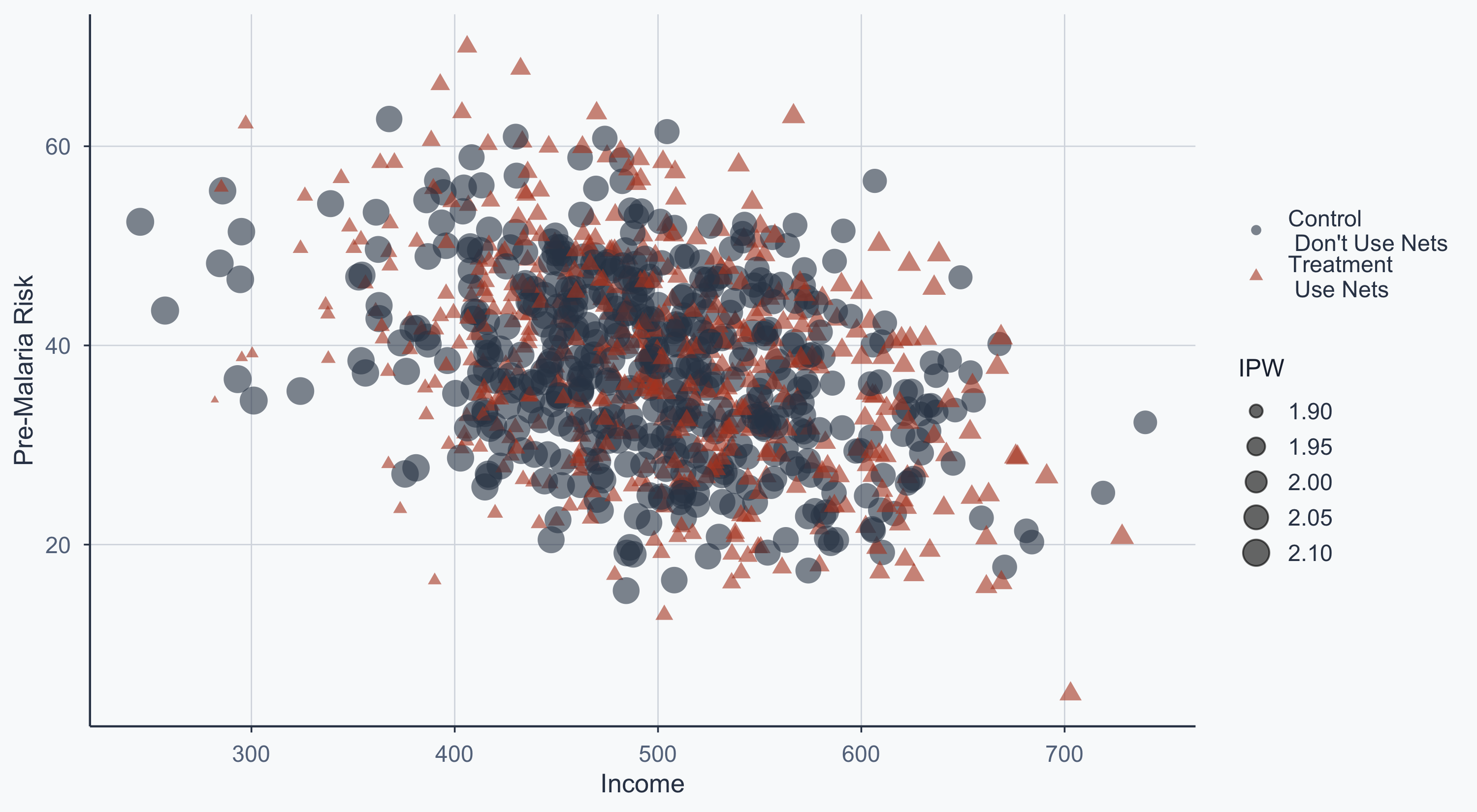
Point size reflects the inverse probability weight — unusual observations get more weight:

Show code
rct_ipw3 <- subset(rct_ipw2, select = c(id, ipw))
rct3 <- left_join(rct2, rct_ipw3, by = "id")

ggplot(rct3, aes(x = income, y = malaria_risk_pre)) +
  geom_point(aes(shape = type, color = type, size = ipw), alpha = 0.6) +
  scale_shape_manual(name = "", values = c(16, 17)) +
  scale_color_manual(name = "", values = cols) +
  scale_size_continuous(name = "IPW", range = c(1, 6)) +
  scale_x_continuous(name = "Income") +
  scale_y_continuous(name = "Pre-Malaria Risk") +
  theme_meridian() +
  theme(legend.position = "right")
Three-Way Comparison

x1 <- lm(malaria_risk_post ~ net, data = rct_data)
x2 <- lm(malaria_risk_post ~ net, data = matched)
x3 <- lm(malaria_risk_post ~ net, data = rct3, weights = ipw)

models <- list("Naive Regression" = x1,
               "Matched" = x2,
               "IPW" = x3)
modelsummary(models, stars = TRUE, gof_map = c("nobs", "r.squared"))
Naive Regression Matched IPW
+ p < 0.1, * p < 0.05, ** p < 0.01, *** p < 0.001
(Intercept) 45.662*** 45.662*** 45.659***
(0.415) (0.417) (0.404)
net -10.083*** -10.069*** -10.075***
(0.574) (0.589) (0.572)
Num.Obs. 1000 956 1000
R2 0.236 0.234 0.237

Three-Way Comparison

Both matching and IPW adjust the naive estimate downward — the raw difference partly reflected confounding, not the causal effect of nets.

Conclusion

When to Use What?

Method Keeps all obs? Requires model? Best when…
Mahalanobis matching No No (but assumes distance metric is appropriate) Good overlap, few confounders
IPW Yes Yes (logit) Losing too many observations

In this example, we only lost 44 observations (1000 → 956), so Mahalanobis matching is acceptable. With more imbalanced data, IPW preserves sample size.

Key Takeaways

  1. DAGs encode your causal assumptions — they tell you what to control for
  2. Without randomization, confounders create back-door paths that bias naive estimates
  3. Matching creates comparable groups by pairing similar treated and control units
  4. IPW re-weights observations instead of dropping them — a different solution to the same problem
  5. In this case, both methods adjust the treatment effect downward — the naive estimate partly reflected confounding, not causation