Statistical Analysis

Lecture 11: Theories of Change

Bogdan G. Popescu

John Cabot University

Introduction

From Regression to Causality

  • Previous weeks: how to estimate relationships
  • This week: how to identify causal relationships
  • Key question: does \(X\) cause \(Y\), or just correlate?
  • Tools: DAGs, potential outcomes, randomization

Public Policy Programs

Elements of a Program

A public policy program contains four elements:

  1. Inputs: time, money, people
  2. Activities: actions that convert inputs into outputs
  3. Outputs: tangible goods and services produced
  4. Outcomes: changes after the population uses outputs

\[\text{Inputs} \rightarrow \text{Activities} \rightarrow \text{Outputs} \rightarrow \text{Outcomes}\]

Example: Math Education Program

Inputs: budget, municipal training facilities

Activities: teacher training, textbook development

Outputs: 10,000 teachers trained, 1M textbooks delivered

Outcomes: students improve on final math exams

Measuring Outcomes

  • Inputs, activities, outputs are directly measurable
  • Outcomes are abstract and harder to measure
  • We need indicators that:
    • Reflect the concepts of interest
    • Are feasible to collect
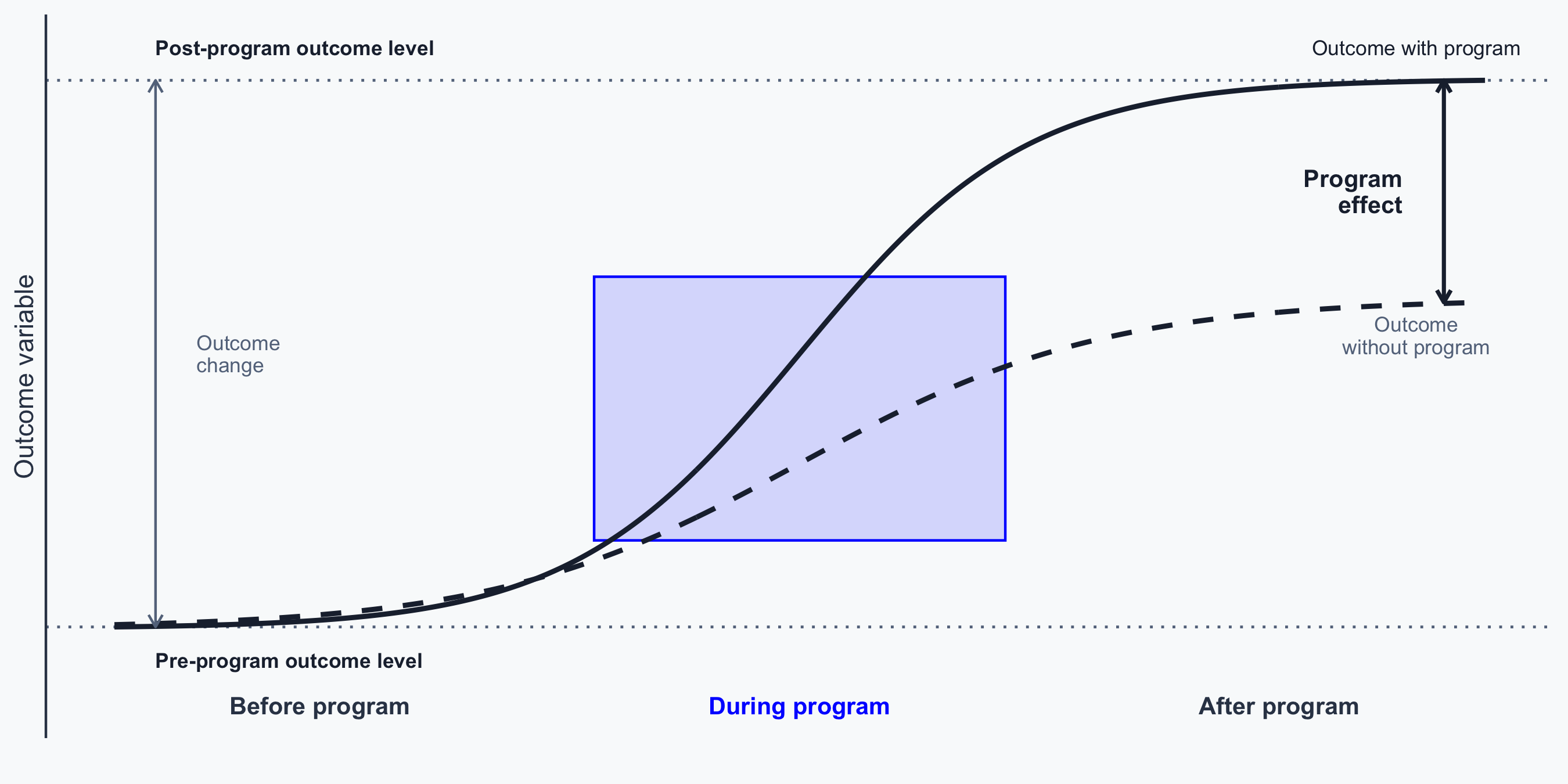
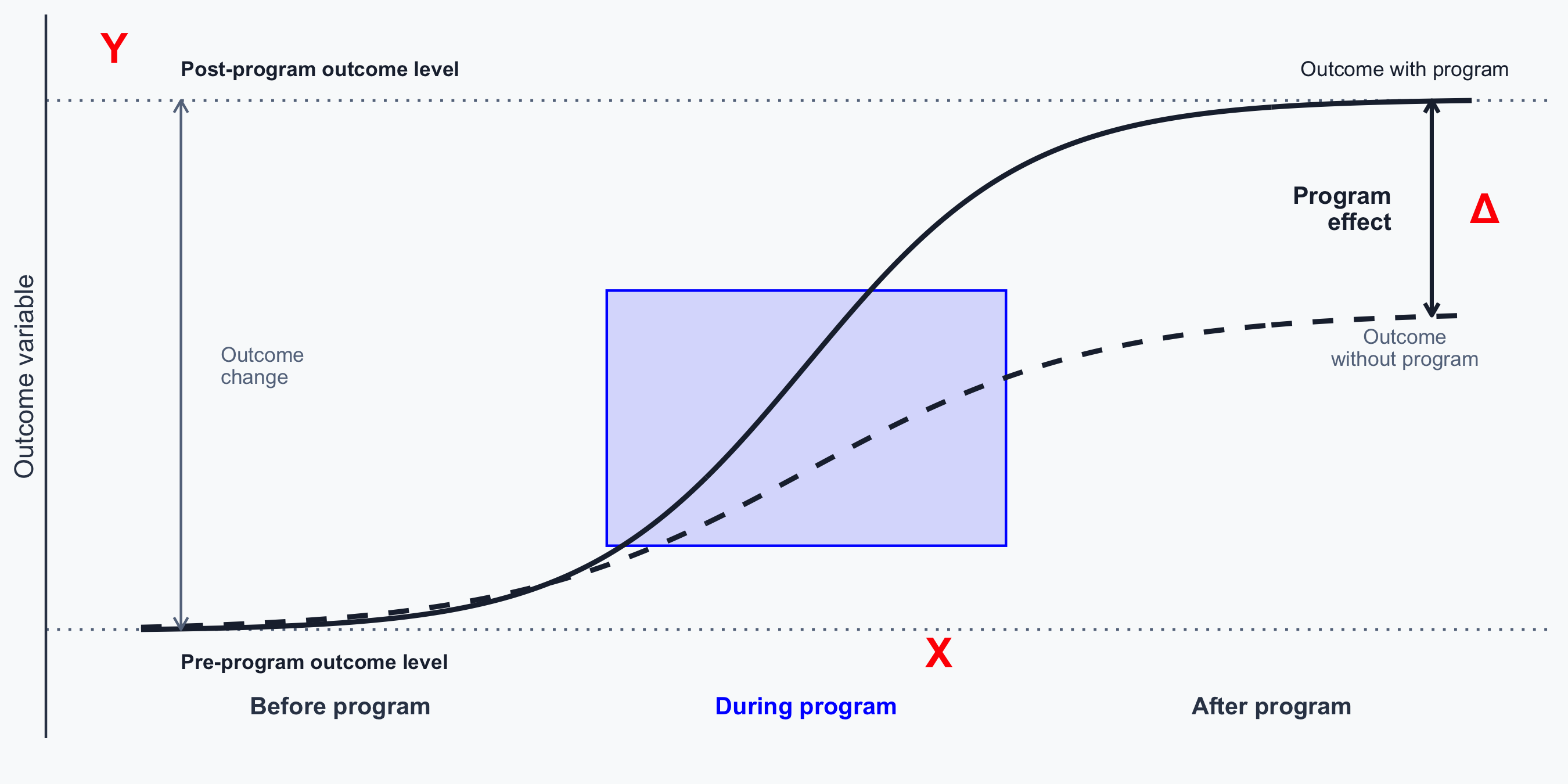
  • Once measured, we care about change caused by the program

Outcomes and Programs

Types of Data

Experimental Data

  • Researcher controls which units get treated
  • Proving causation is easier

Observational Data

  • No control over which units get treated
  • Proving causation is harder

Causal Diagrams

What Is a DAG?

Directed Acyclic Graphs (DAGs):

  • Directed: arrows point from cause to effect
  • Acyclic: no cycles; arrows go one direction only
  • Graph: a visual representation of relationships
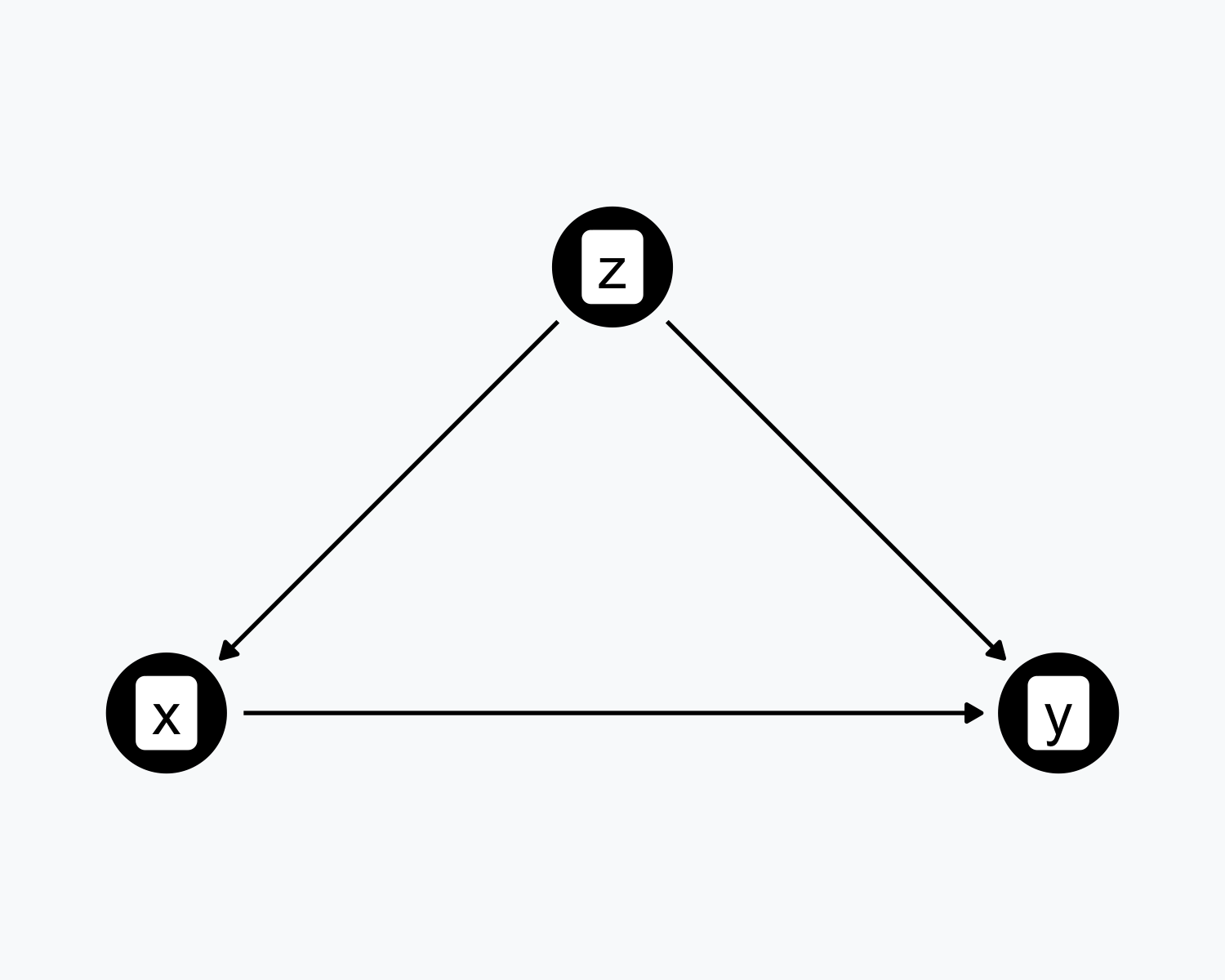
Why Use DAGs?

  • A DAG represents the theoretical model behind the data
  • Shows what to control for to identify causal effects
  • A causal effect is identified when confounders are removed

How to Draw a DAG

Four steps:

  1. List all relevant variables
  2. Simplify by grouping related variables
  3. Connect with arrows using domain knowledge
  4. Assess which paths need to be controlled

Step 1: List Variables

Example — factors affecting life expectancy:

  1. GDP
  2. Education
  3. Public services
  4. Health care
  5. Urbanization
  6. Conflict

Step 2: Simplify

Group related variables:

  • Health care \(\rightarrow\) subsumed under Public services
  • Crime rates \(\rightarrow\) subsumed under Conflict

Simplified: GDP, Education, Public services, Urbanization, Conflict

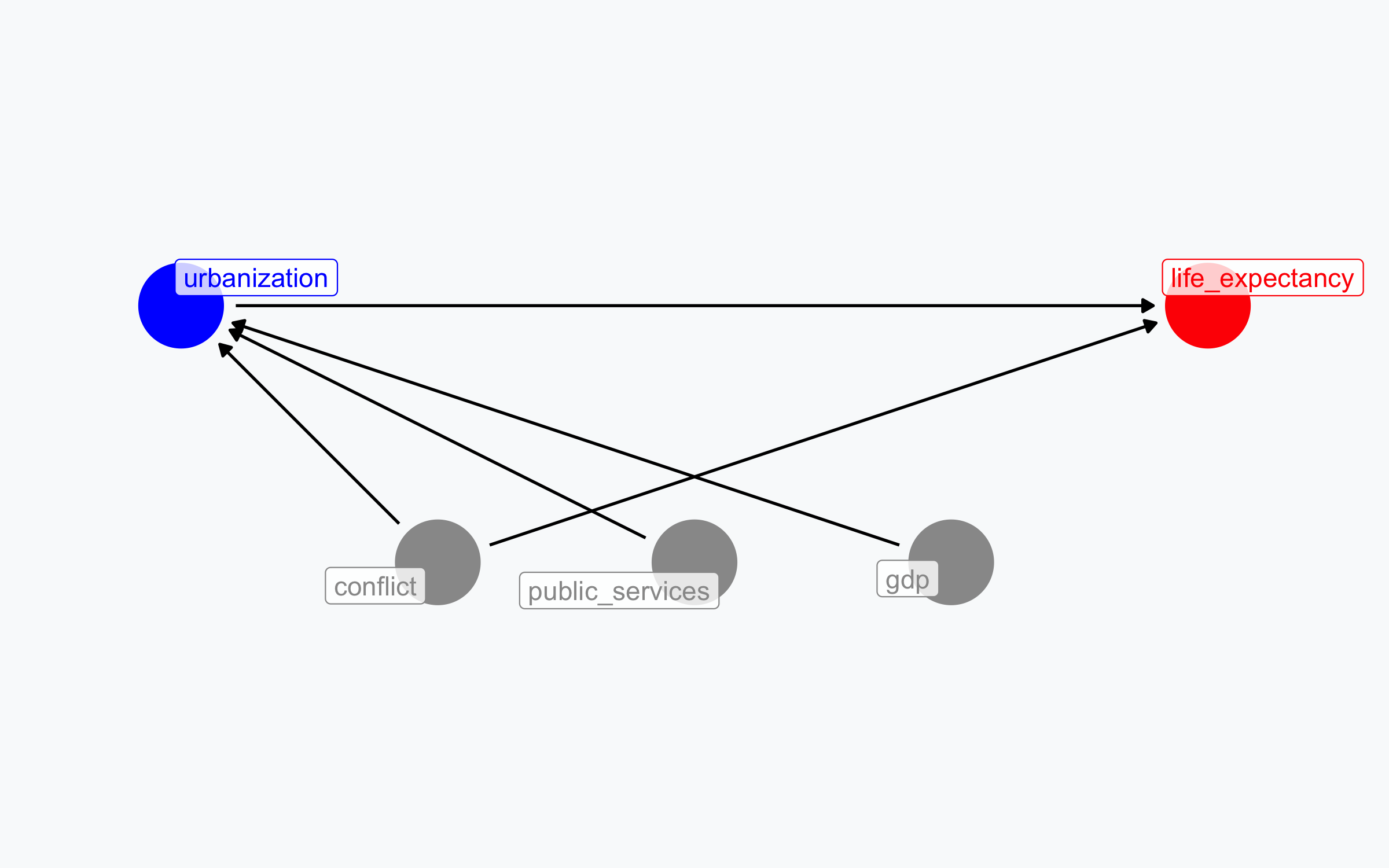
Steps 3–4: Connect Arrows

  • GDP, conflict, public services \(\rightarrow\) urbanization
  • Conflict also \(\rightarrow\) life expectancy directly

Causal Identification

  • Nodes connected by arrows are correlated
  • We care about the effect of urbanization on life expectancy
  • A causal effect is identified when the \(X \rightarrow Y\) link is isolated
  • DAG arrows help understand which paths to control

Types of Associations

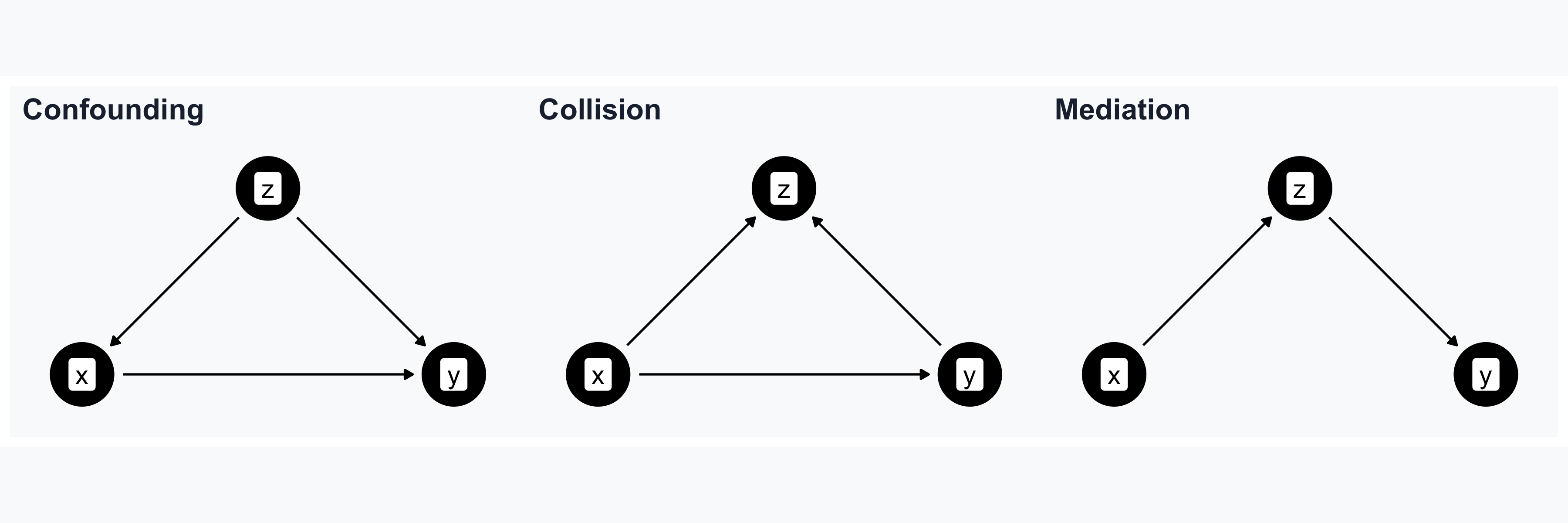
Three Types of Associations

Type Role of \(Z\) Problem?
Confounding \(Z\) causes both \(X\) and \(Y\) Yes
Collision \(X\) and \(Y\) both cause \(Z\) Yes
Mediation \(X \rightarrow Z \rightarrow Y\) Helpful

Confounding

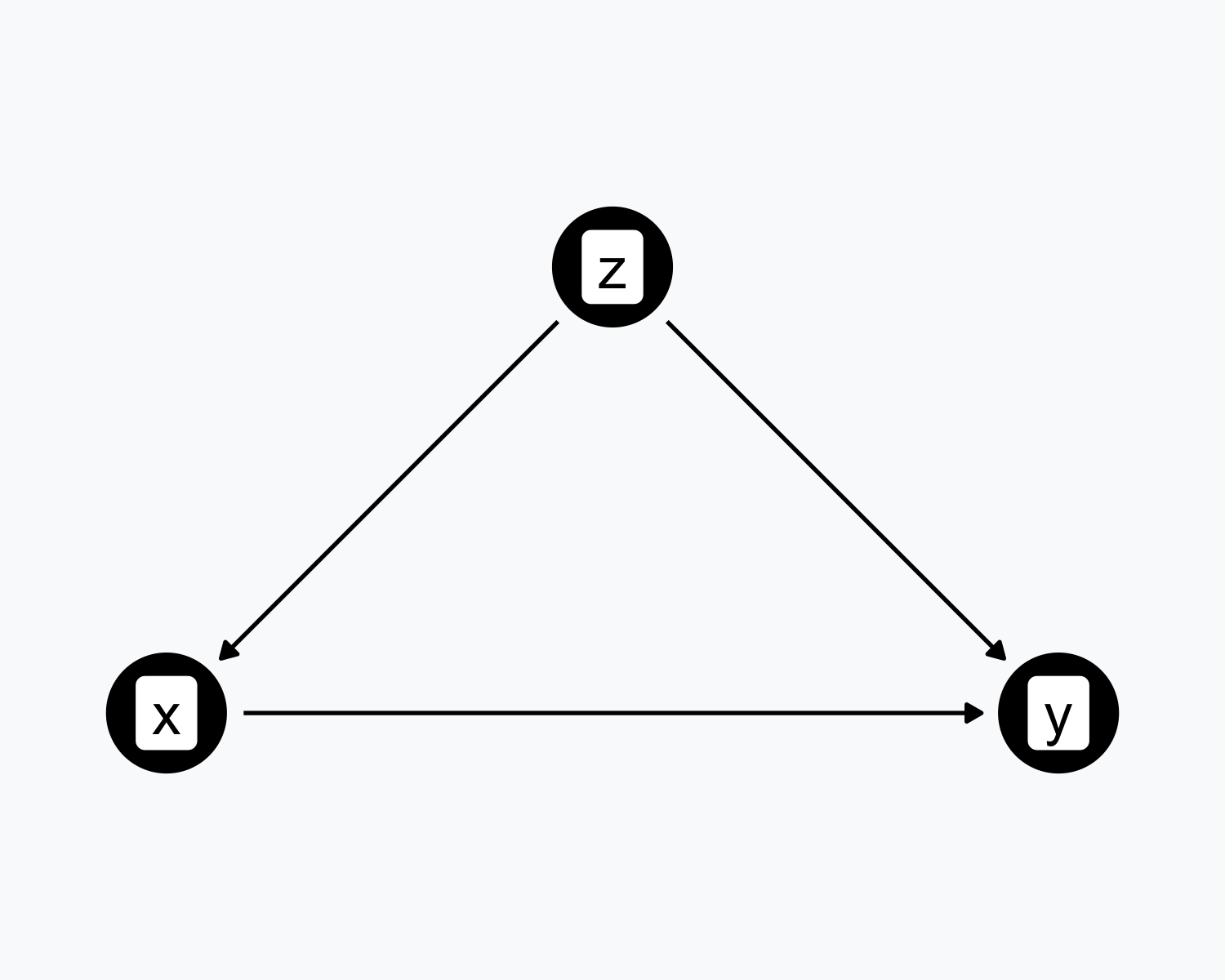
  • \(Z\) causes both \(X\) and \(Y\)
  • \(Z\) confounds the relationship between \(X\) and \(Y\)
  • The \(X \rightarrow Y\) relationship is not identified

Confounding Example
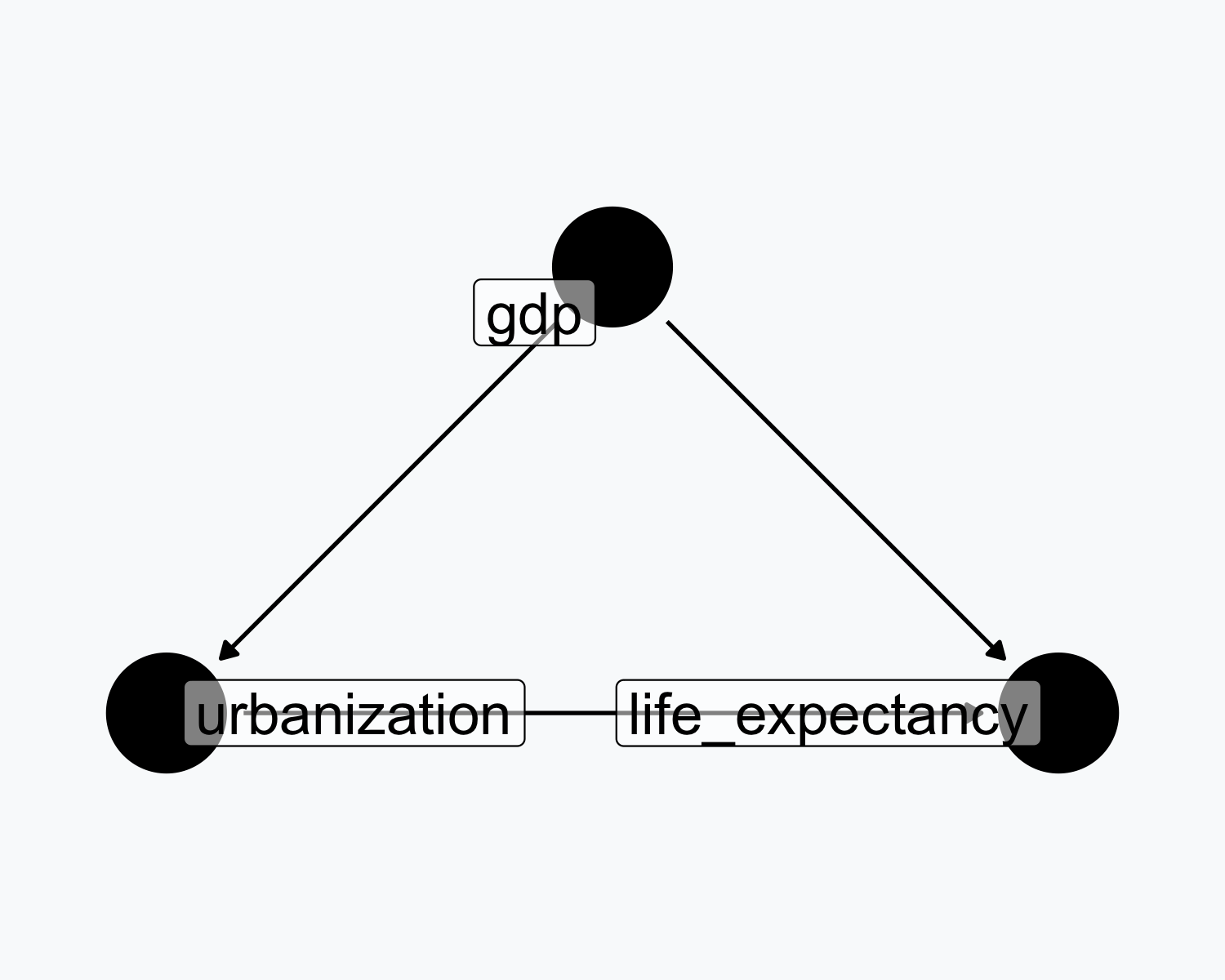
  • GDP causes both urbanization and life expectancy
  • GDP confounds the urbanization \(\rightarrow\) life expectancy link
  • Without controlling for GDP, the effect is biased

Confounding: Solutions

  1. Include the confounder as a control in the regression
  2. Matching: pair treated/untreated with similar \(Z\)
  3. Stratifying: analyze within levels of \(Z\)
  • Most common approach: add \(Z\) to the regression

Confounding in Practice

# Bivariate: ignoring GDP (confounded)
mod_biv <- lm(life_expectancy ~ urbanization, data = final)
# Multivariate: controlling for GDP
mod_multi <- lm(life_expectancy ~ urbanization + log_gdp,
                data = final)

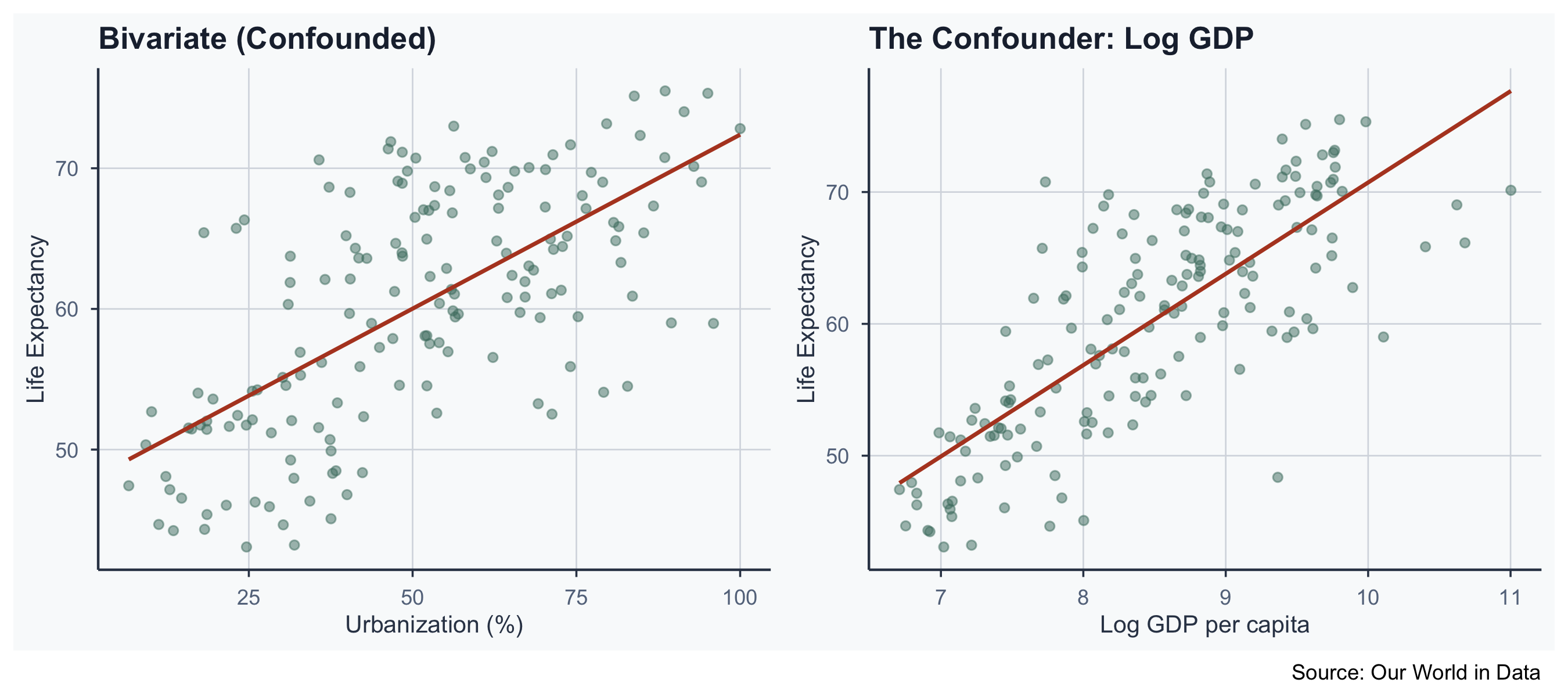
Confounding: The Coefficient Drops

  • Bivariate urbanization effect: 0.247
  • Multivariate urbanization effect: 0.055
  • The coefficient drops after controlling for GDP
  • GDP was inflating the apparent urbanization effect
  • This is what confounding looks like in practice

Confounding: Visualized

Collision

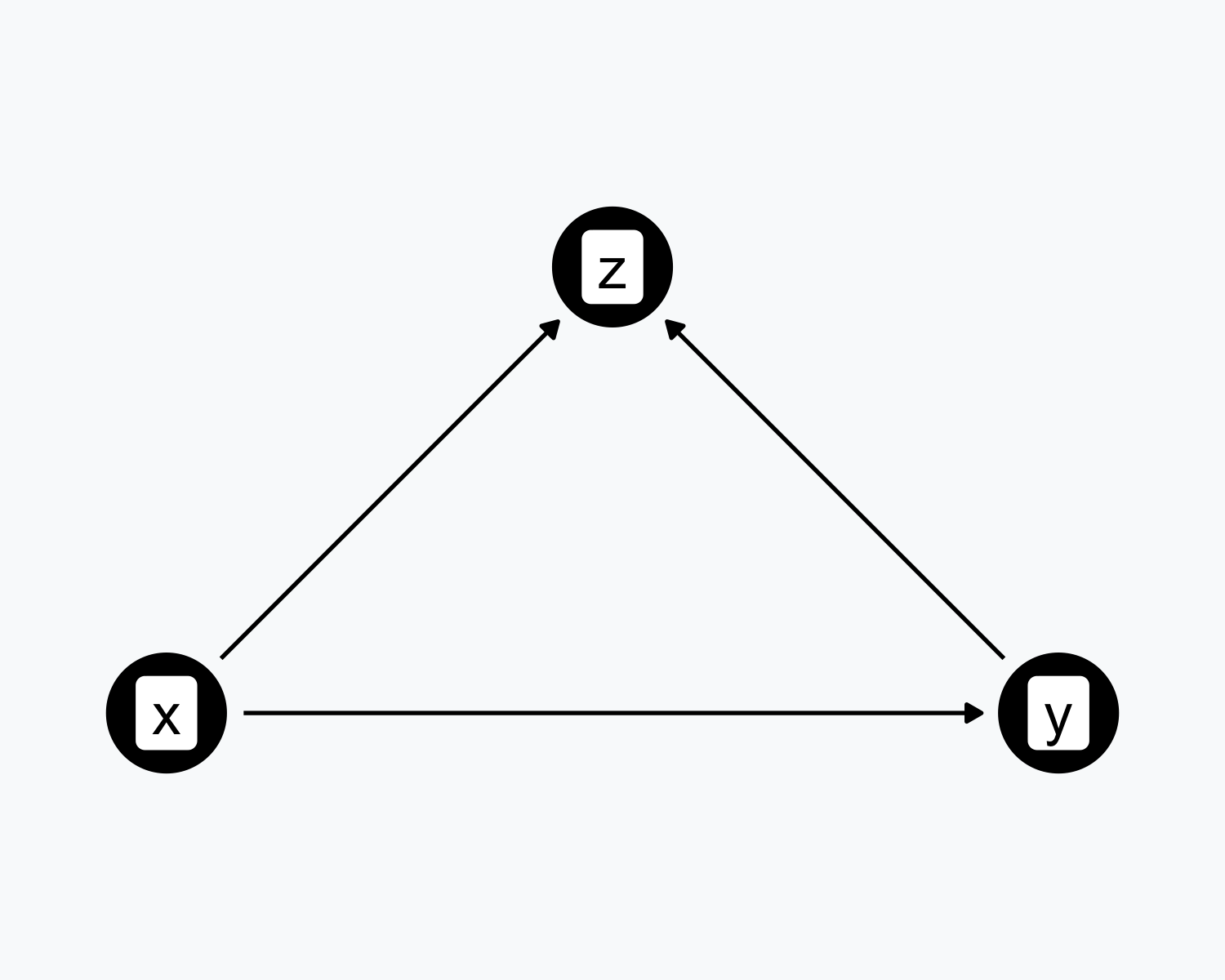
  • \(X\) and \(Y\) both cause \(Z\) (the collider)
  • Controlling for \(Z\) creates a spurious association

Collision Example
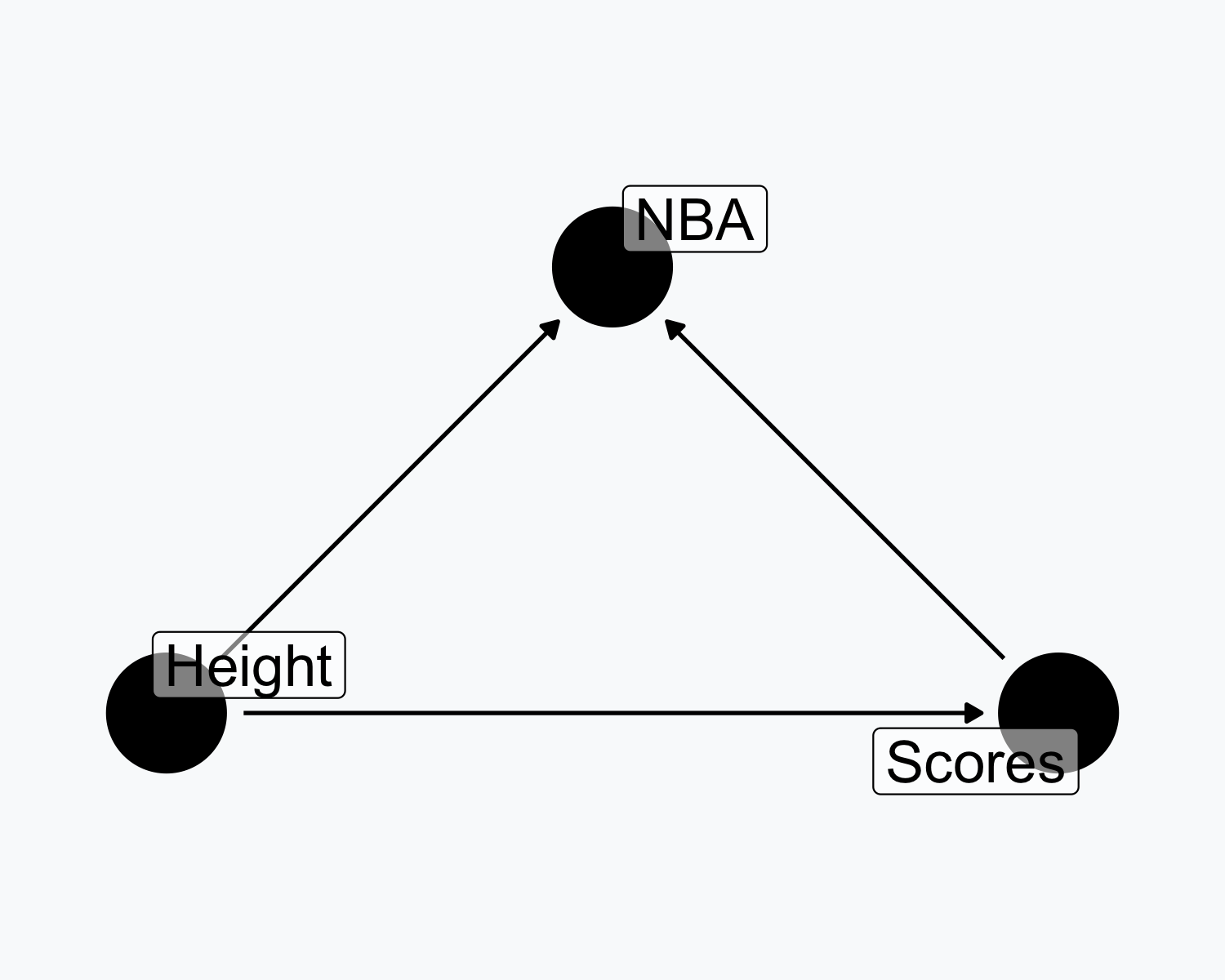
  • Height and scoring both cause NBA recruitment
  • Controlling for NBA status creates a false link

Collision: Solutions

  • Collect additional data beyond the collider group
    • Include both NBA and non-NBA players
  • Restrict the sample to avoid conditioning on \(Z\)
    • Analyze only non-NBA players
  • Key rule: do not control for colliders

Mediation

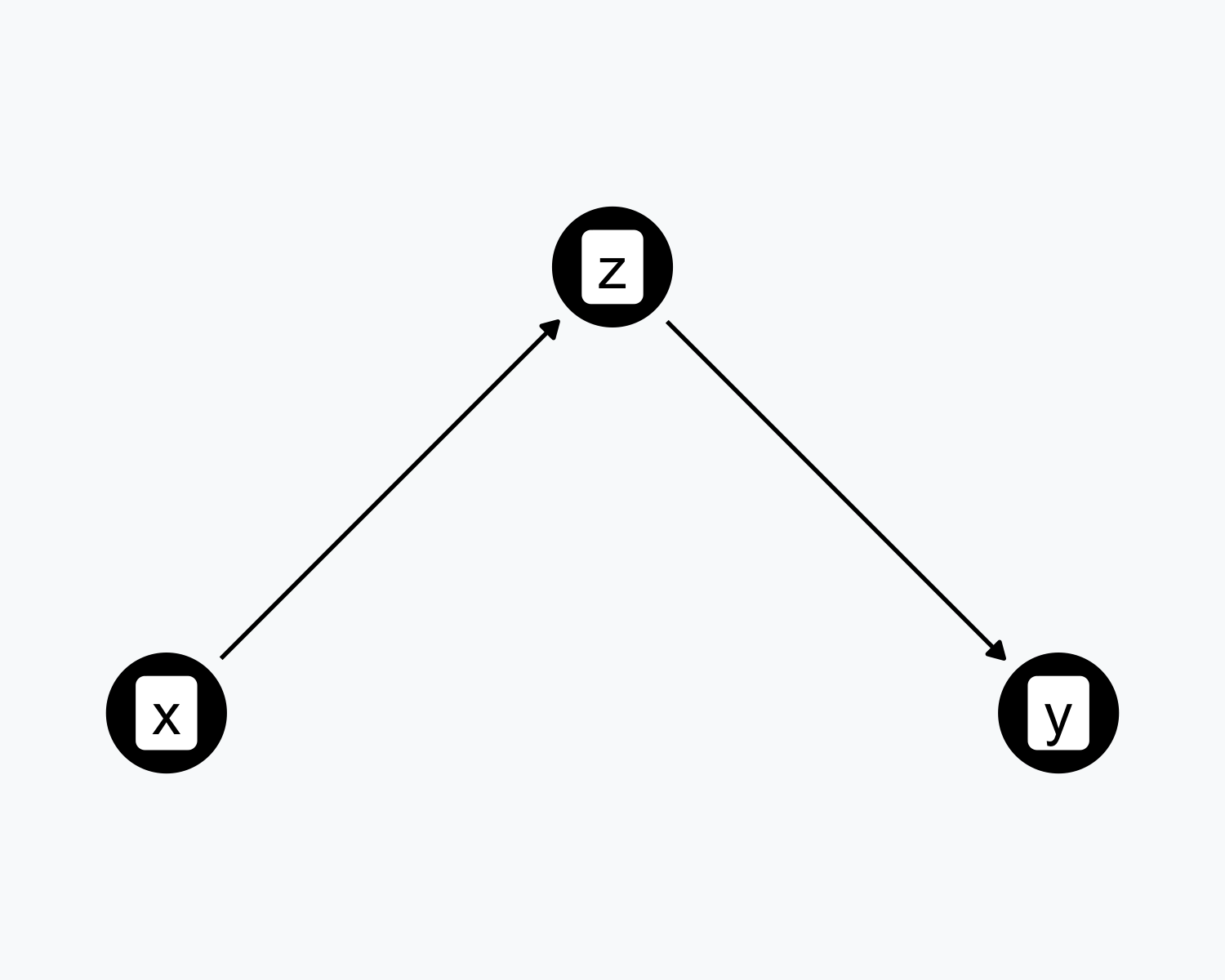
  • \(X\) causes \(Z\), and \(Z\) causes \(Y\)
  • \(Z\) is a mediator on the causal path

Mediation Example
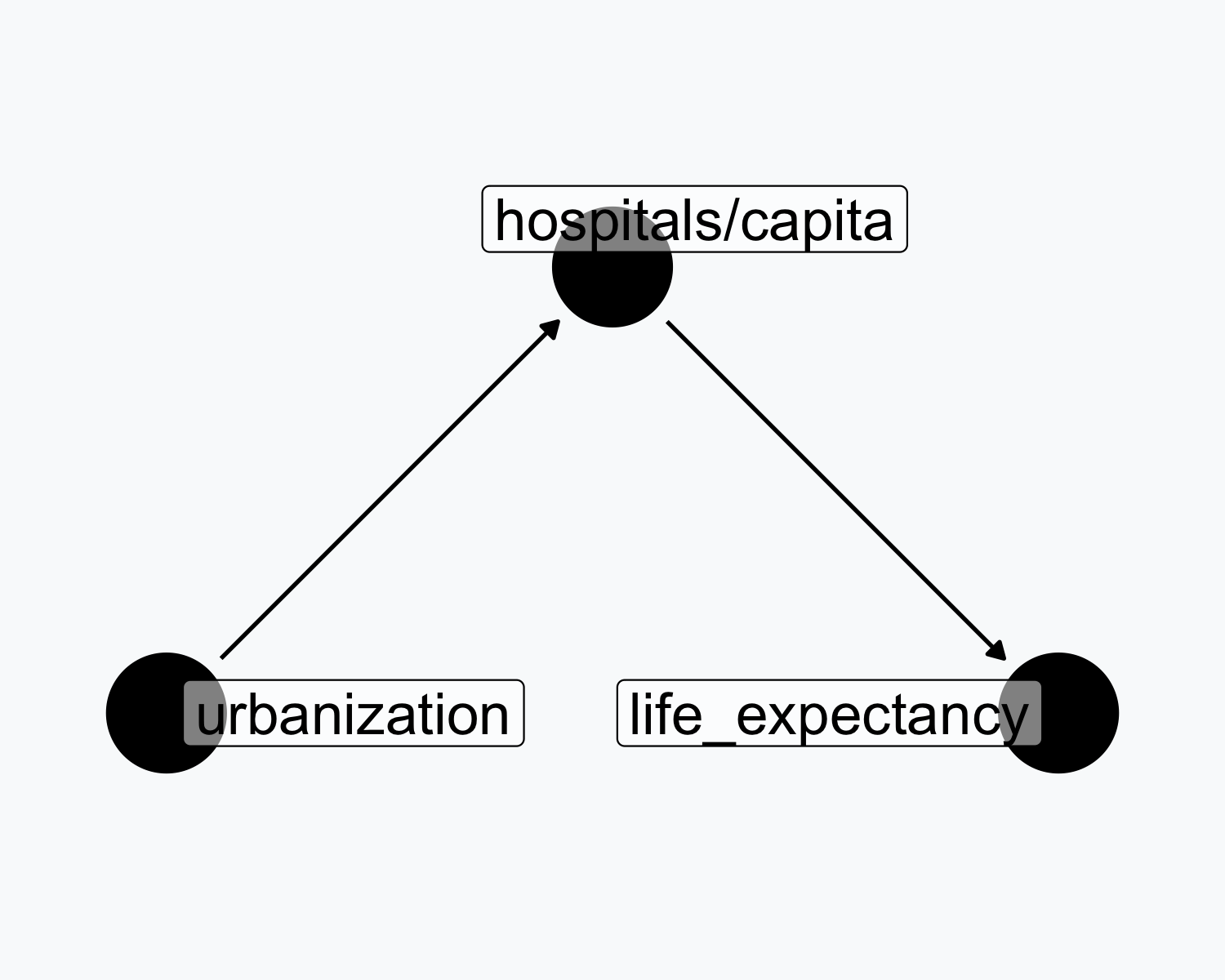
  • Urbanization \(\rightarrow\) hospitals/capita \(\rightarrow\) life expectancy
  • Hospitals mediate the urbanization effect

Testing for Mediation

Run four regressions:

  1. \(Y = \beta_0 + \beta_1 X + \epsilon\)
  2. \(M = \beta_0 + \beta_1 X + \epsilon\)
  3. \(Y = \beta_0 + \beta_1 M + \epsilon\)
  4. \(Y = \beta_0 + \beta_1 X + \beta_2 M + \epsilon\)
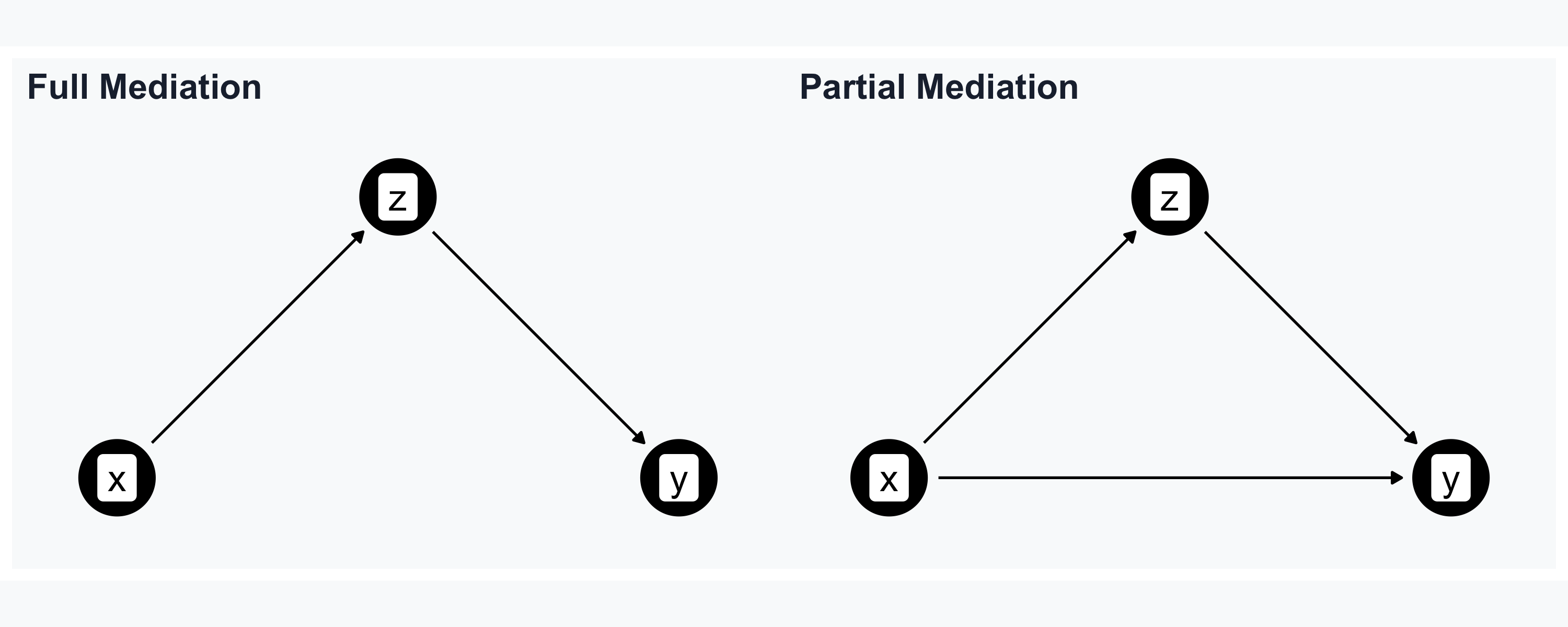
  • If \(X\) becomes insignificant in (4): full mediation
  • If \(X\) is reduced but significant: partial mediation

Full vs. Partial Mediation

  • Full: all of \(X\)’s effect passes through \(Z\)
  • Partial: \(X\) affects \(Y\) directly and through \(Z\)

Summary of Variable Relationships
Causality

Causality Notation

We write the causal effect as:

\[E(Y \mid X = x)\]

“Expected value of \(Y\), given that \(X\) takes value \(x\)

Examples:

  • \(E(\text{life expectancy} \mid \text{+1 pct. pt. urbanization})\)
  • \(E(\text{income} \mid \text{+1 year of education})\)
  • \(E(\text{malaria risk} \mid \text{insecticide-treated net})\)

Causality in RCTs

In RCTs, we control who gets treated — confounders vanish
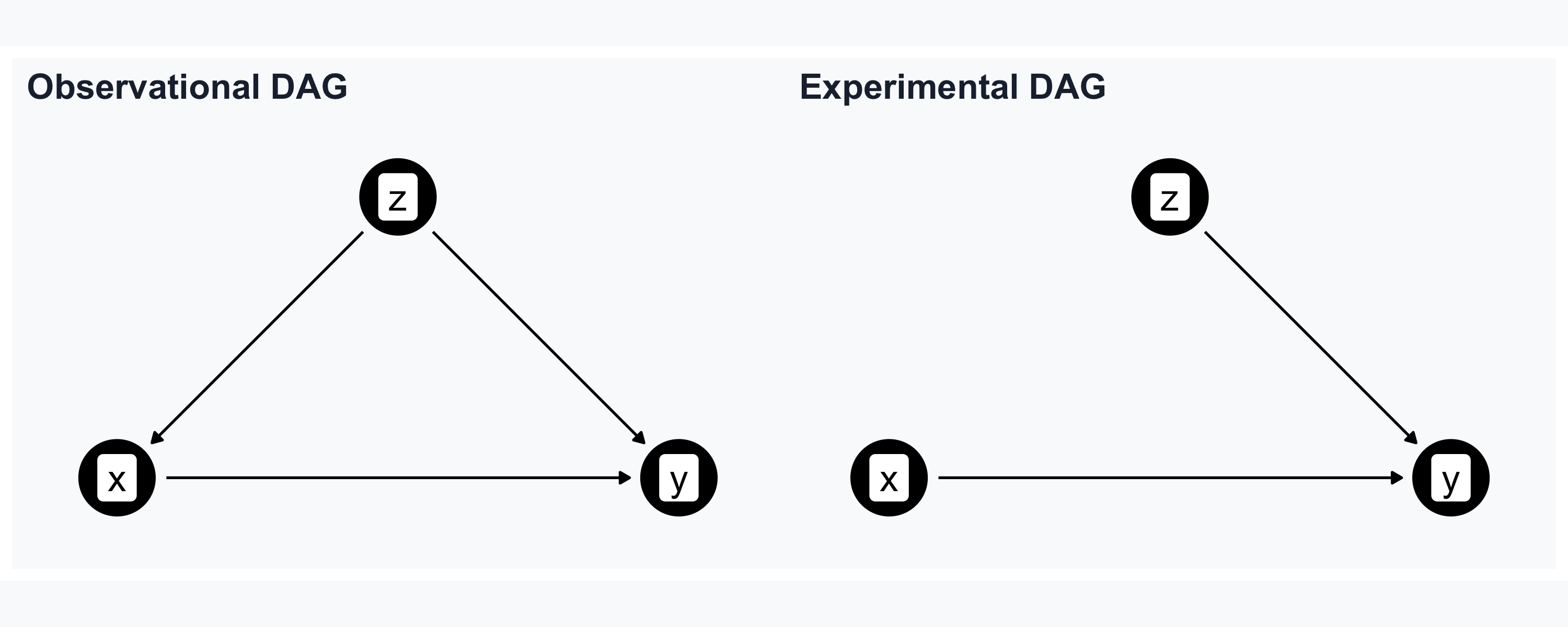
  • Randomization breaks the arrow from \(Z\) to \(X\)

Correlation \(\neq\) Causation

\[P(Y \mid X = x) \neq P(Y \mid X)\]

  • \(P(Y \mid X)\) gives a correlation, not a causal effect
  • A simple regression captures association, not causation
  • Causal identification requires controlling confounders or randomization

Potential Outcomes Framework

The Counterfactual Problem

Potential Outcomes Notation

In a treatment vs. control setting:

\[\Delta = E(Y \mid X = 1) - E(Y \mid X = 0)\]

  • \(Y^1_i\): outcome for individual \(i\) if treated
  • \(Y^0_i\): outcome for individual \(i\) if untreated
  • \(\Delta_i = Y^1_i - Y^0_i\): individual treatment effect

The Fundamental Problem

We can never observe both potential outcomes for one person:

\[\Delta_i = Y^1_i - \text{ ?}\]

  • A patient either takes the pill or does not
  • We cannot observe the counterfactual
  • This is the fundamental problem of causal inference

What We Would Like

Patient Treatment Outcome 1 Outcome 2
1 1 \(Y_1\) (Treated) \(Y_1\) (Untreated)
2 0 \(Y_2\) (Treated) \(Y_2\) (Untreated)
3 1 \(Y_3\) (Treated) \(Y_3\) (Untreated)
4 1 \(Y_4\) (Treated) \(Y_4\) (Untreated)
5 0 \(Y_5\) (Treated) \(Y_5\) (Untreated)

What We Actually Observe

Patient Treatment Outcome 1 Outcome 2
1 1 \(Y_1\) (Treated) ???
2 0 ??? \(Y_2\) (Untreated)
3 1 \(Y_3\) (Treated) ???
4 1 \(Y_4\) (Treated) ???
5 0 ??? \(Y_5\) (Untreated)
  • We only see one potential outcome per person
  • The other is the missing counterfactual

Average Treatment Effects

ATT and ATU

We compute group averages from what we observe:

Average Treatment on the Treated (ATT):

\[ATT = \bar{Y}_T \mid X = 1\]

Average Treatment on the Untreated (ATU):

\[ATU = \bar{Y}_U \mid X = 0\]

Average Treatment Effect (ATE)

Combine ATT and ATU:

\[ATE = ATT - ATU\]

  • ATE estimates the average causal effect of treatment
  • But it may contain selection bias

Selection Bias

\[ATE = (ATT - ATU) + \text{Selection Bias}\]

  • Confounders and colliders cause selection bias
  • In an RCT, selection bias \(= 0\) due to randomization
  • Without randomization, ATE \(\neq\) true causal effect

Example: Bocconi vs. JCU

Effect of graduating from Bocconi on monthly income?

Student Bocconi Income
1 1 2,400
2 0 2,000
3 1 2,500
4 1 2,800
5 0 2,100
6 0 2,000
7 0 2,200

Computing the ATE

\[ATT = \frac{2400 + 2500 + 2800}{3} \approx 2567\]

\[ATU = \frac{2000 + 2100 + 2000 + 2200}{4} = 2075\]

\[ATE \approx 2567 - 2075 = 492\]

  • But this is an observational study
  • \(492 = (ATT - ATU) + \text{Selection Bias}\)

Selection Bias in the Example

Why might there be selection bias?

  • Students choosing Bocconi may prefer finance/economics
  • These fields tend to have higher incomes
  • The “Bocconi effect” is confounded by career preferences
  • We cannot isolate the true university effect

Randomization

Why Randomize?

Randomization makes treatment independent of potential outcomes:

\[X \perp\!\!\!\perp Y^1, Y^0\]

  • Mean potential outcomes are identical across groups
  • Selection bias \(= 0\)
  • ATE equals the observed difference in group means

What Randomization Ensures

  • Treated and untreated groups are comparable
    • Same average height, income, education, etc.
  • Differences in outcomes are caused by treatment
  • Not by pre-existing differences between groups

Internal & External Validity

Internal validity: findings are reliable for the sample

External validity: findings generalize to the population

  • RCTs have strong internal validity
  • External validity depends on sample representativeness

Conclusion

Summary

  • Programs: inputs \(\rightarrow\) activities \(\rightarrow\) outputs \(\rightarrow\) outcomes
  • DAGs: directed acyclic graphs map causal structure
  • Confounding: \(Z\) causes both \(X\) and \(Y\); control for \(Z\)
  • Potential outcomes: the counterfactual we cannot observe
  • ATE \(=\) ATT \(-\) ATU; may include selection bias
  • Randomization: eliminates selection bias in RCTs