Comparative Politics

Lecture 3: Colonial Legacies

Bogdan G. Popescu

John Cabot University

The Puzzle

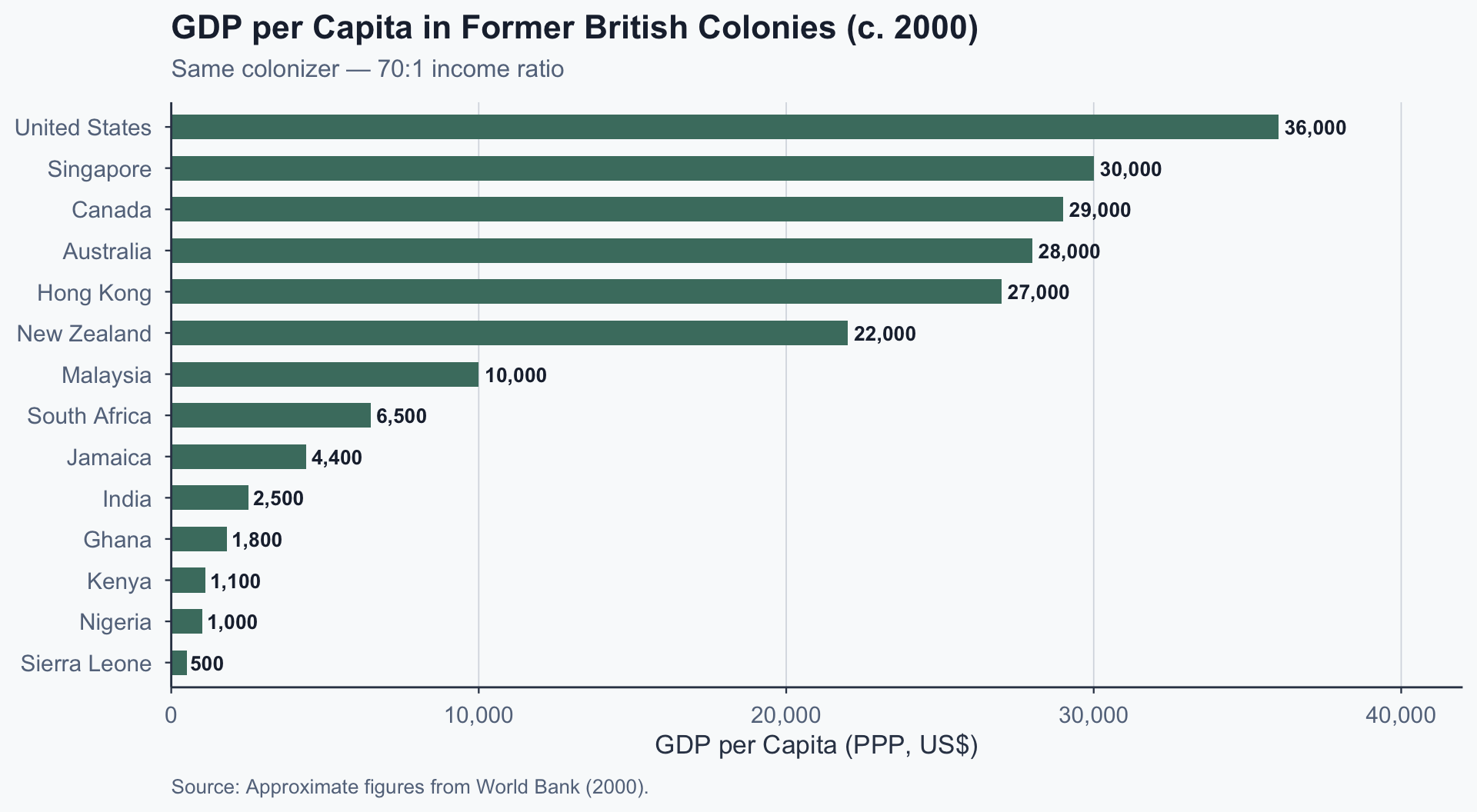
The Divergence Puzzle

Figure 1: Source: Approximate figures from World Bank (2000), PPP dollars.

Why the Divergence?

Same colonizer. Same language. Same legal tradition.

Radically different outcomes.

Three candidate explanations:

  • Geography: climate, disease, natural resources
  • Institutions: colonial rules that persist after independence
  • Human capital: skills and knowledge settlers brought

Which one — and how would we tell them apart?

So What?

The divergence is not random. Something systematic separates rich former colonies from poor ones.

We need a theory that explains the pattern — and a method that tests it.

Next: Acemoglu, Johnson & Robinson provide the theory.

AJR: The Macro Framework

The AJR Argument

Acemoglu, Johnson & Robinson (2001) propose a single causal chain:

  • European settler mortality varied dramatically across colonies
  • High mortality → Europeans don’t settle → extractive institutions
  • Low mortality → Europeans settle → property-rights institutions
  • Institutional form persists → explains income differences today

The Causal Chain

%%{init: {'theme': 'base', 'themeVariables': {'fontSize': '22px', 'primaryColor': '#4a7c6f', 'primaryTextColor': '#f9fafb', 'primaryBorderColor': '#3a6e62', 'lineColor': '#b44527', 'edgeLabelBackground': '#f9fafb'}, 'flowchart': {'useMaxWidth': true, 'nodeSpacing': 50, 'rankSpacing': 70}, 'width': 1100, 'height': 650}}%%
flowchart LR
    A["Settler<br/>Mortality"] --> B["Settlement<br/>Patterns"]
    B --> C["Institutional<br/>Form"]
    C --> D["Long-Run<br/>Income"]

Source: Author’s diagram based on Acemoglu, Johnson & Robinson (2001).

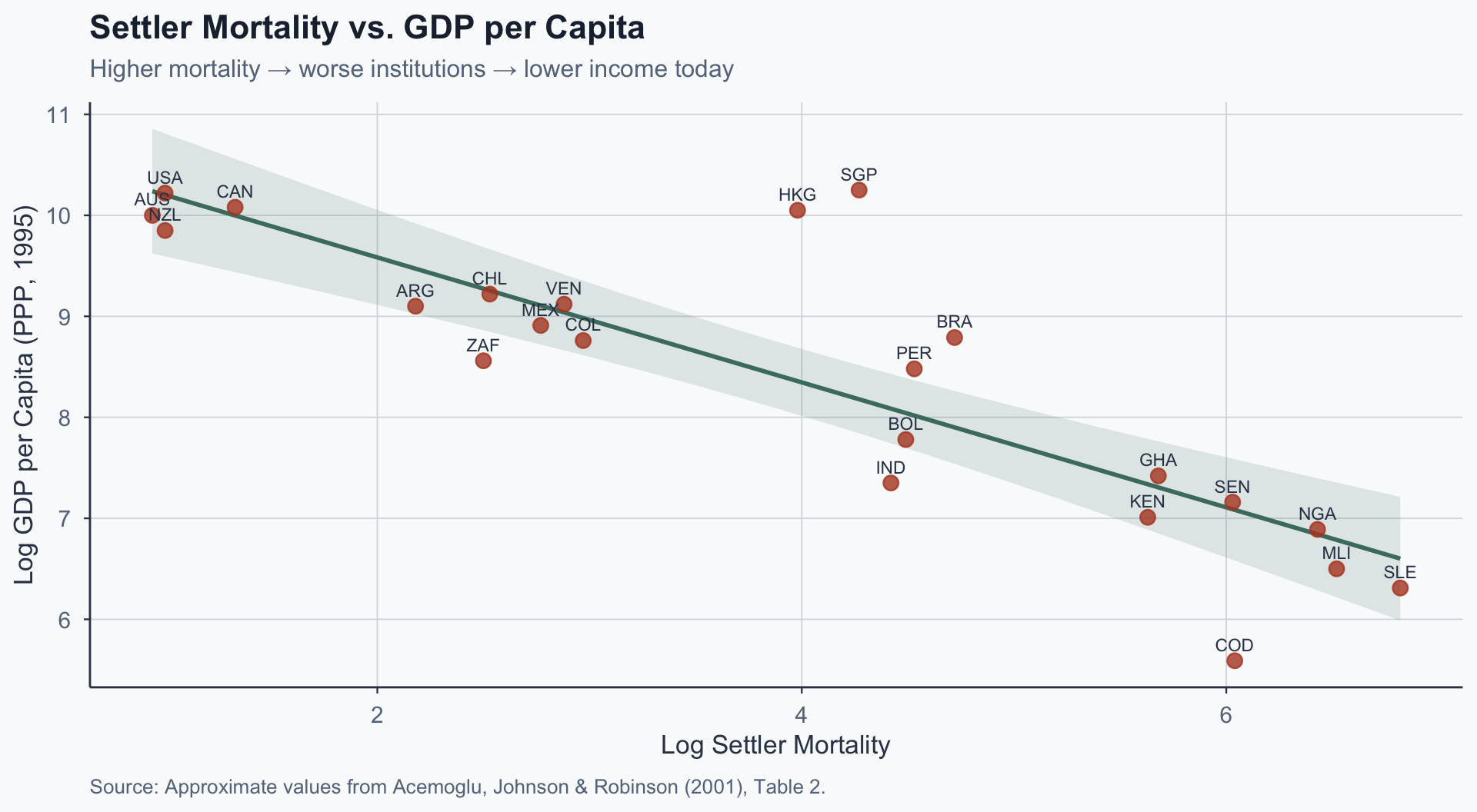
Settler Mortality and Income

Figure 2: Source: Approximate values from Acemoglu, Johnson & Robinson (2001), Table 2.

The IV Logic

AJR use settler mortality as an instrument for institutions:

The idea: mortality shaped where Europeans settled, which shaped institutions, which shaped income.

Exclusion restriction: settler mortality affects income only through institutions.

If valid: this isolates the causal effect of institutions on development.

Extractive vs. Inclusive Institutions

Source: Author’s illustration based on AJR (2001).
Dimension Extractive Inclusive
Property rights Elite only Broadly protected
Political access Narrow Broad-based
Economic rents Concentrated Distributed
Rule of law Selective Generalized

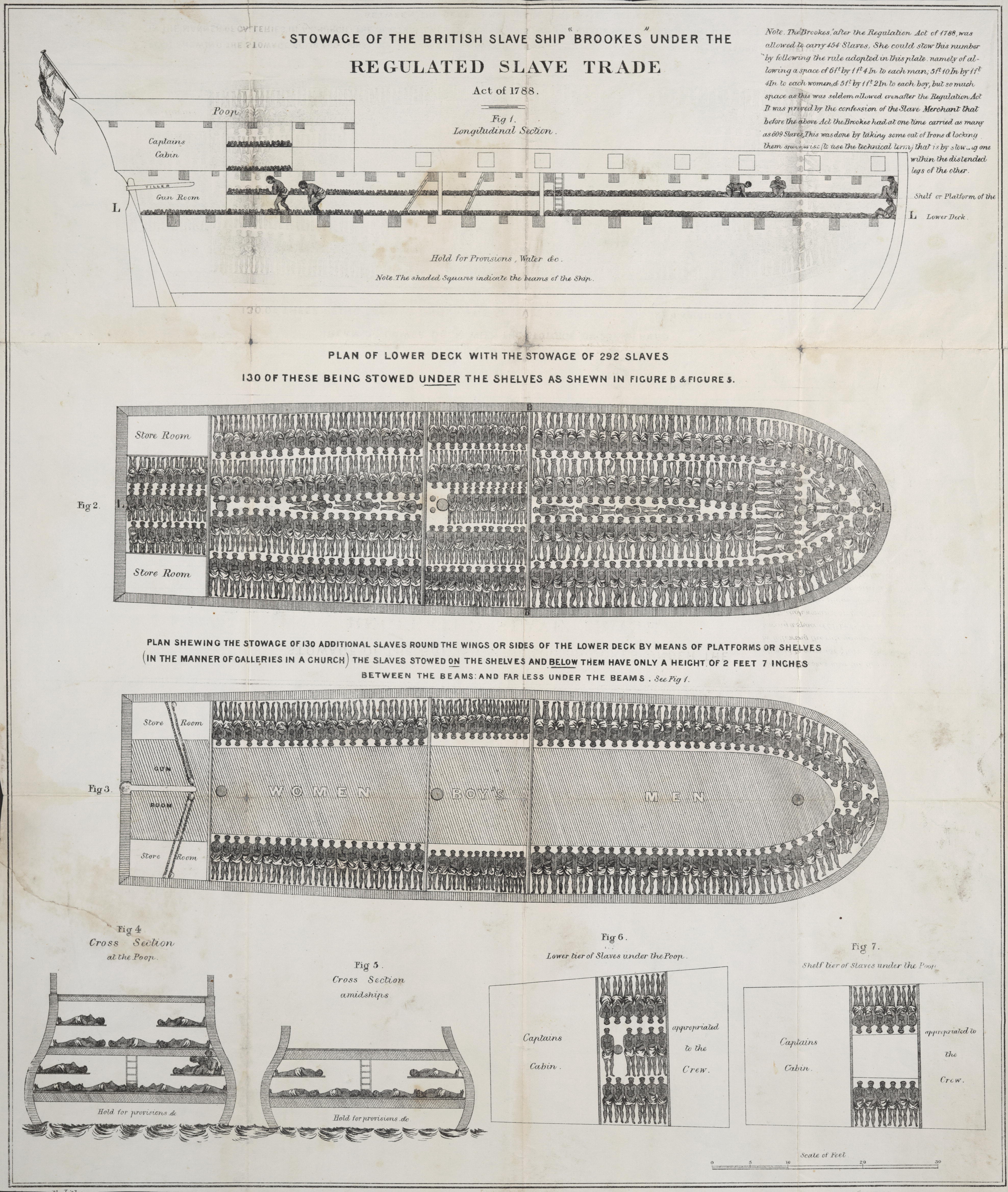
Stowage of the slave ship Brookes (1788). Source: Plymouth abolition committee (public domain).

The Critiques

Albouy (2012): Settler mortality data is unreliable

  • Many estimates from military campaigns, not settlers
  • Small coding changes make the results fragile

Glaeser, La Porta, Lopez-de-Silanes & Shleifer (2004):

  • Settlers brought human capital, not just institutions
  • Schooling predicts growth as well as institutional measures
  • The IV cannot distinguish institutions from education

Big theory, but which specific mechanism?

So What?

AJR gives us the macro scaffolding: colonial institutions cause divergent development.

But the theory can’t tell us which specific institution or which mechanism drives persistence.

Next: Dell (2010) sharpens the test with one labor system and a precise boundary.

Dell: The Sharp Test

What Was the Mita?

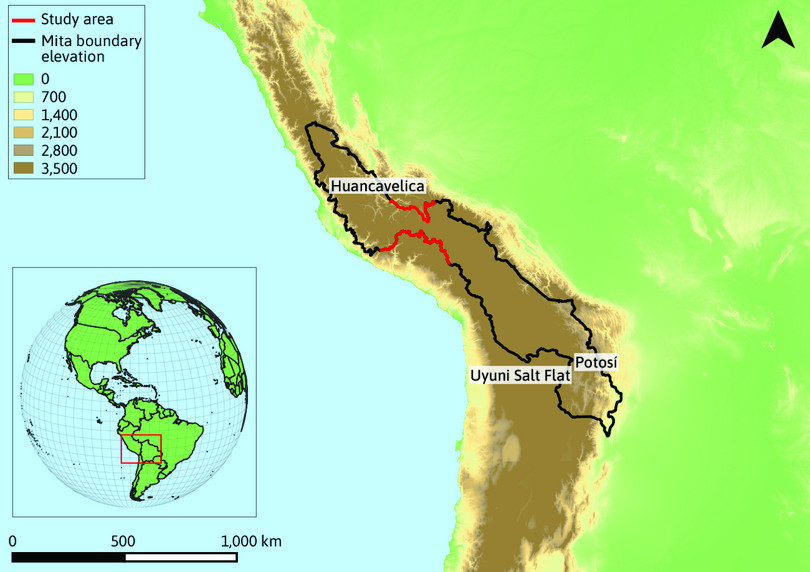
Spanish colonial forced labor system (1573–1812):

  • Indigenous communities conscripted for mines
  • Potosí (Bolivia) and Huancavelica (Peru)
  • ~200 districts within a defined boundary
  • One of the largest forced labor systems in history
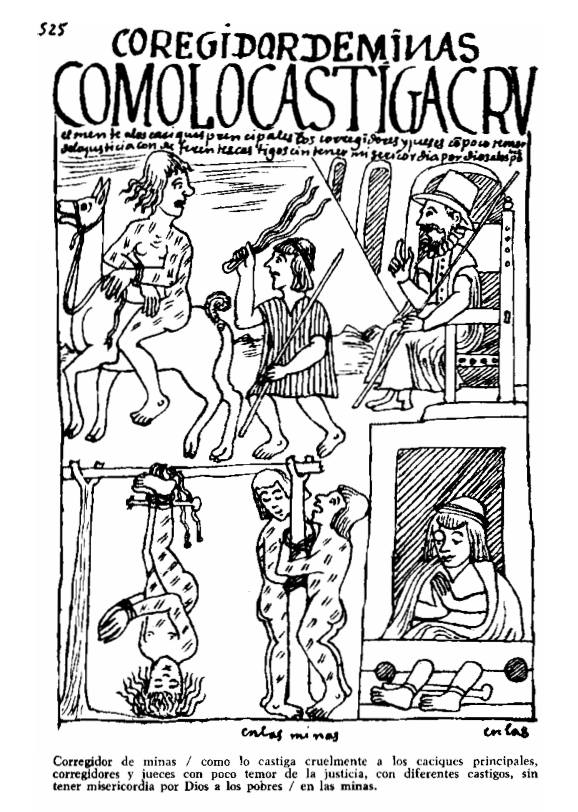
Mita forced labor in the mines. Source: Felipe Guaman Poma de Ayala, c. 1615 (public domain).

Dell’s Core Finding

Inside vs. outside the Mita boundary today (Dell, 2010):

  • 25% lower household consumption
  • 6 percentage points higher child stunting
  • Effects persist 200 years after abolition
  • The boundary has no modern function

The Mita boundary and study area. Source: Dell (2010).

The Full Causal Chain

%%{init: {'theme': 'base', 'themeVariables': {'fontSize': '20px', 'primaryColor': '#4a7c6f', 'primaryTextColor': '#f9fafb', 'primaryBorderColor': '#3a6e62', 'lineColor': '#b44527', 'edgeLabelBackground': '#f9fafb'}, 'flowchart': {'useMaxWidth': true, 'nodeSpacing': 40, 'rankSpacing': 55}, 'width': 1100, 'height': 650}}%%
flowchart LR
    A["Mita<br/>(Forced Labor)"] --> B["Population<br/>Collapse"]
    B --> C["Fewer<br/>Haciendas"]
    C --> D["Weaker Political<br/>Representation"]
    D --> E["Fewer<br/>Public Goods"]
    E --> F["Lower<br/>Consumption<br/>Today"]

Source: Author’s diagram based on Dell (2010).

What Is an RDD?

Regression Discontinuity Design — the core intuition:

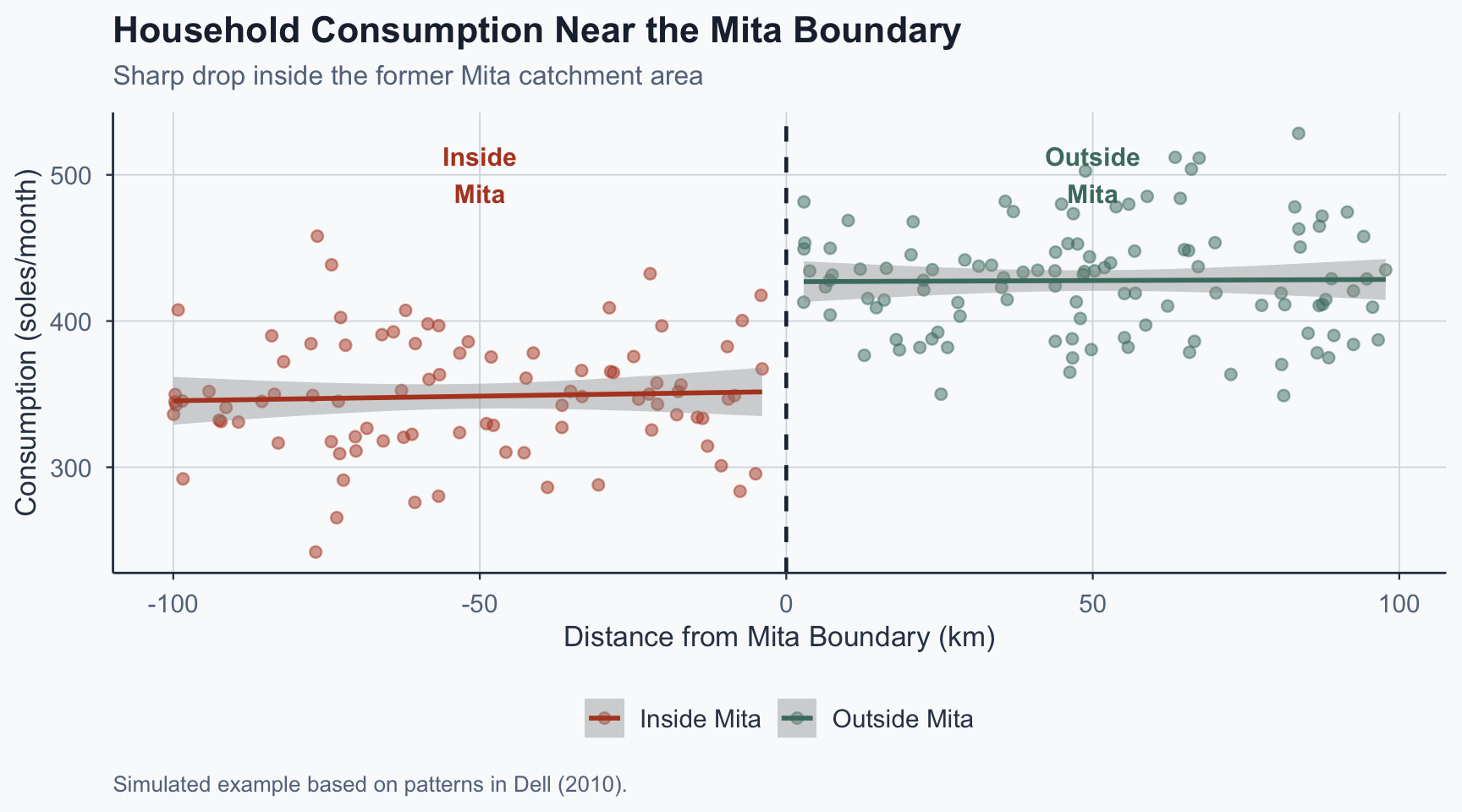
  • Villages on either side of the Mita boundary are nearly identical
  • Same geography, altitude, ethnicity, climate
  • Only difference: inside or outside the Mita catchment
  • Any outcome difference → attributable to the Mita itself

Compare units that are nearly identical except for one thing: treatment.

RDD: Visual Intuition

Figure 3: Simulated example illustrating RDD logic at the Mita boundary.

AJR vs. Dell: Comparing Designs

Source: Author’s comparison.
Feature AJR (2001) Dell (2010)
Unit of analysis Countries Villages
Source of variation Settler mortality Mita boundary
Comparison Colony A vs. B Village A vs. neighbor B
Identification Instrumental variable Geographic discontinuity
Specificity “Institutions” (broad) One labor system

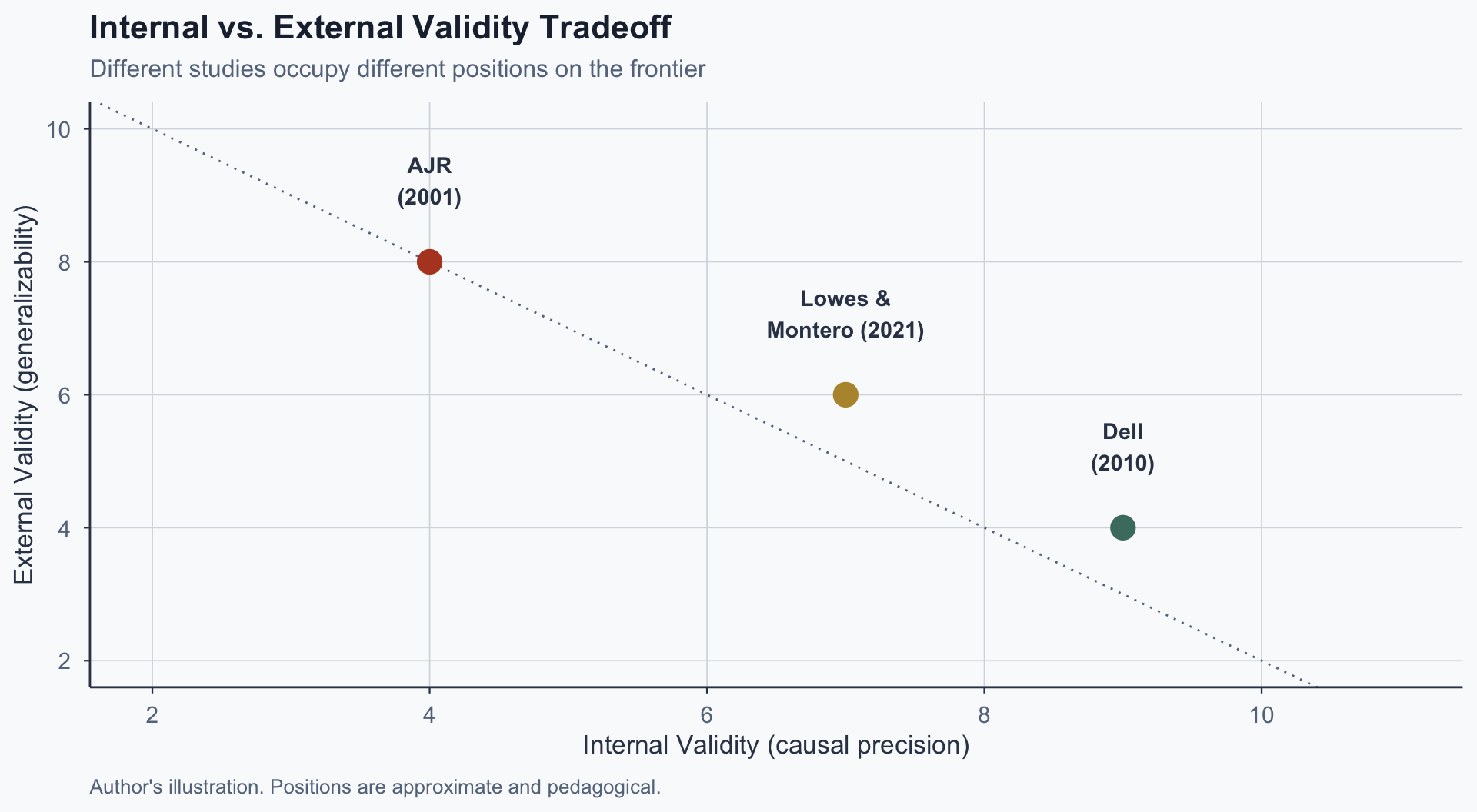
Stronger identification, but narrower scope. This is the credibility-generalizability tradeoff.

So What?

Dell identifies a clean causal effect of one colonial labor system on modern outcomes.

But does this tell us about “colonialism” broadly — or just one institution in one place?

Next: The persistence puzzle — why do colonial effects last centuries?

The Persistence Puzzle

Three Channels of Persistence

Why do colonial effects last centuries after independence?

%%{init: {'theme': 'base', 'themeVariables': {'fontSize': '22px', 'primaryColor': '#4a7c6f', 'primaryTextColor': '#f9fafb', 'primaryBorderColor': '#3a6e62', 'lineColor': '#334155', 'edgeLabelBackground': '#f9fafb'}, 'flowchart': {'useMaxWidth': true, 'nodeSpacing': 50, 'rankSpacing': 60}, 'width': 1100, 'height': 650}}%%
flowchart LR
    A["Colonial<br/>Experience"] --> B["Formal<br/>Institutions"]
    A --> C["Human<br/>Capital"]
    A --> D["Trust &<br/>Norms"]
    B --> E["Development<br/>Today"]
    C --> E
    D --> E

Source: Author’s illustration.

Lowes & Montero: The Congo Concessions

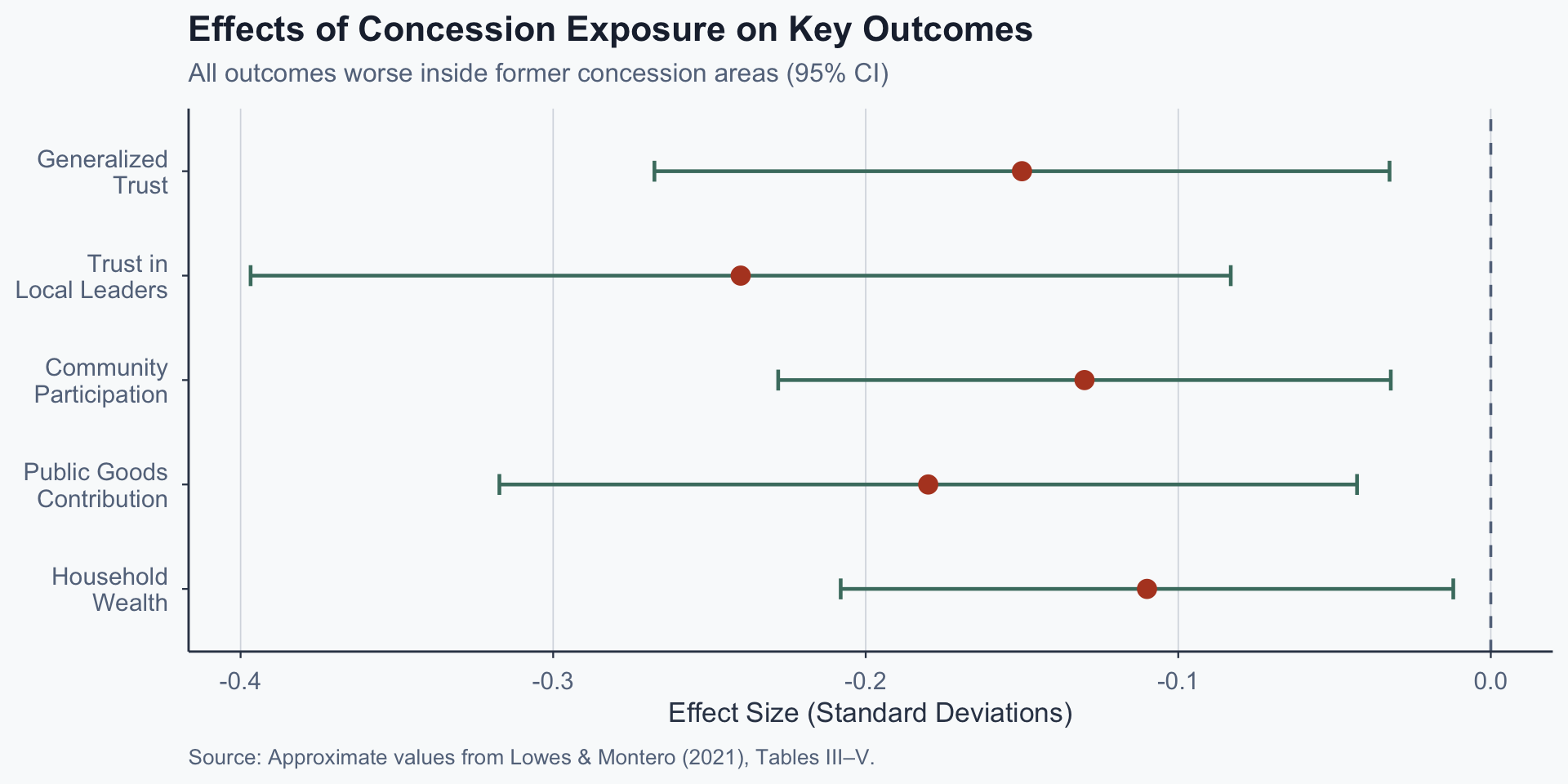
Lowes & Montero (2021) test the behavioral channel:

  • Congo Free State (1885–1908): Leopold II’s private empire
  • Private companies granted rubber extraction monopolies
  • Forced labor enforced through systematic violence
  • RDD at concession boundaries — same logic as Dell
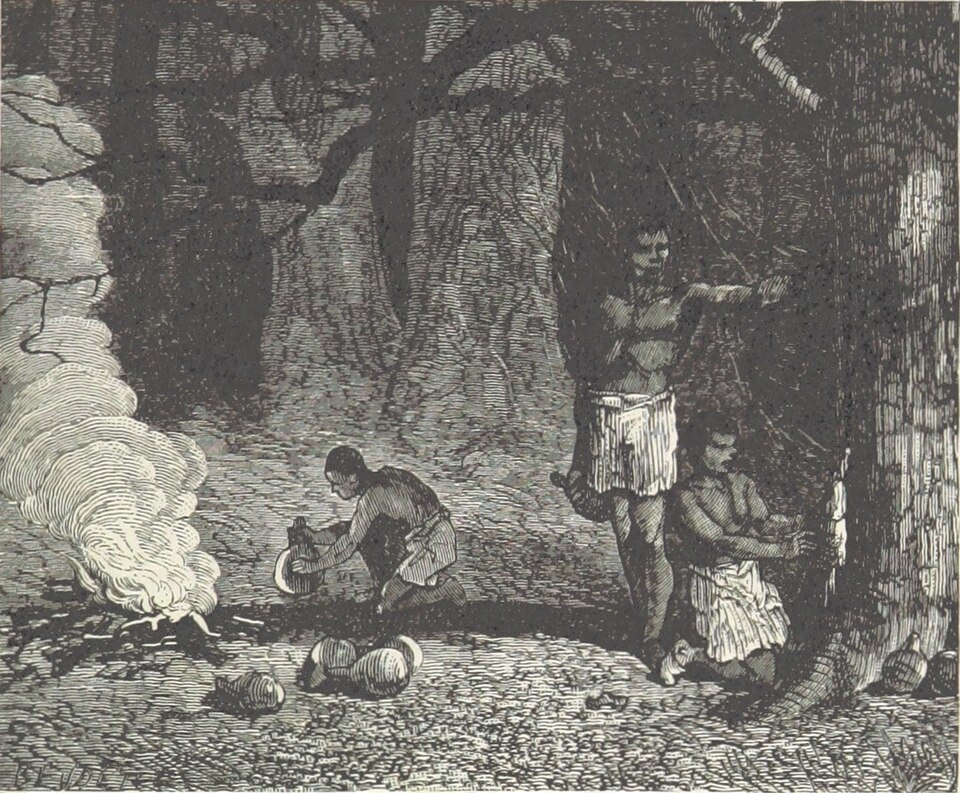
Rubber harvesting in the Congo, c. 1890. Source: Wikimedia Commons (public domain).

Violence as the Business Model

How rubber quotas were enforced:

  • Hostage-taking of women and children
  • Mutilation for missed quotas
  • Village burning to enforce compliance

Violence was public and collective — it destroyed norms of cooperation and community safety.
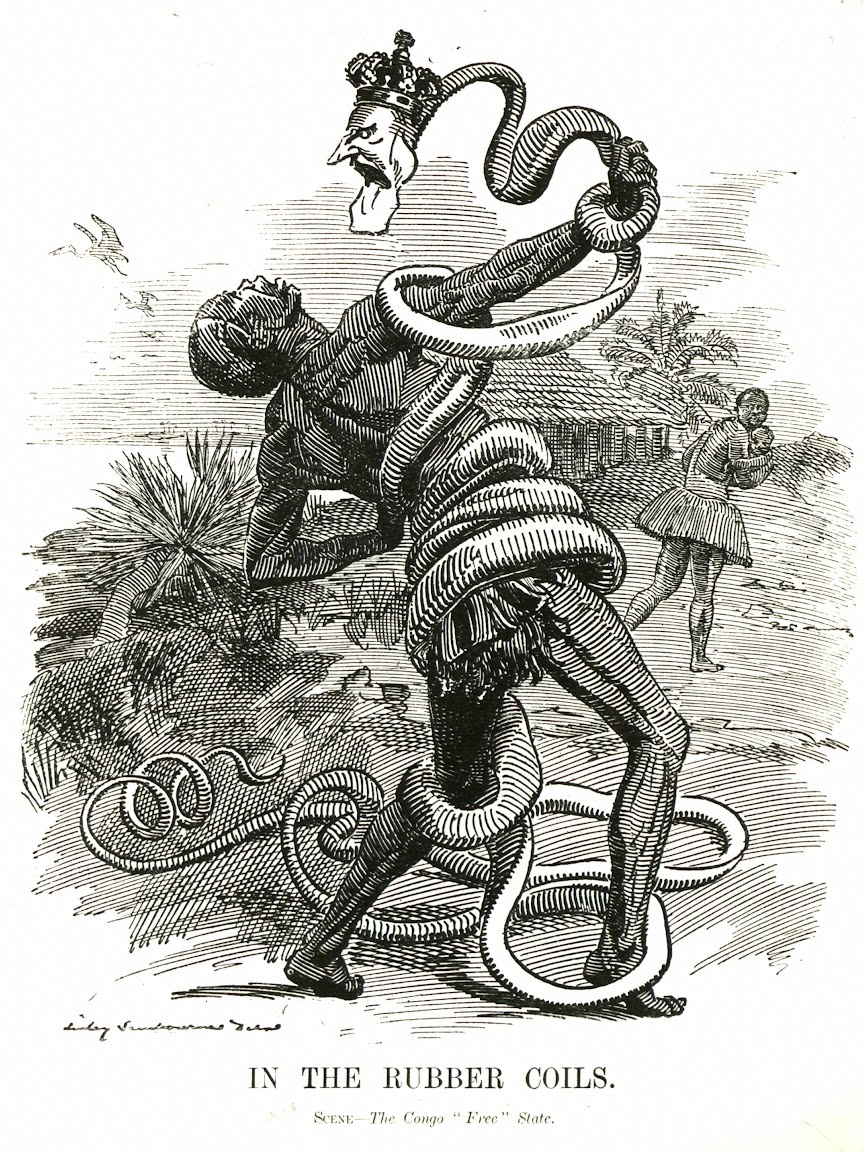
“In the Rubber Coils,” Punch, 1906. Source: Wikimedia Commons (public domain).

Indirect Rule: Chiefs as Enforcers

Indigenous chiefs were conscripted as quota enforcers:

  • Europeans couldn’t supervise the vast interior directly
  • Chiefs forced to organize labor and deliver quotas
  • Chiefs who resisted were replaced or killed
  • Chiefs who complied became agents of extraction

Either way, local authority was delegitimized. The institution survived in form but lost its legitimacy.

Effects of Concession Exposure

Figure 4: Source: Approximate values from Lowes & Montero (2021), Tables III–V.

Dell vs. Lowes & Montero

Source: Author’s comparison.
Dimension Dell (2010) Lowes & Montero (2021)
Location Peru Congo
Extraction Silver mining (Mita) Rubber (concessions)
Channel Institutional destruction Trust + legitimacy erosion
Mechanism Elites eliminated → no lobby Chiefs co-opted → authority poisoned
Design RDD at Mita boundary RDD at concession boundary

Same outcome (persistent underdevelopment), different mechanism.

Exercise 2: Advising a Post-Colonial Government

Class Exercise (5 min)

Prompt: You are advising a former colony suffering from both weak institutions and low social trust.

  1. Which legacy channel do you prioritize — and why?
  2. Can you fix institutions without fixing trust?
  3. What would “success” look like in 20 years?

So What?

Colonial persistence is not one thing. It works through multiple channels:

  • Formal institutions (AJR, Dell)
  • Human capital (Glaeser et al.)
  • Trust and norms (Lowes & Montero, Nunn & Wantchekon)

Stronger identification → more local claims. Weaker identification → bolder but less credible ones.

Synthesis

The Identification Tradeoff

Figure 5: Author’s illustration. Positions are approximate and pedagogical.

The Full Comparison

Source: Author’s comparison.
AJR (2001) Dell (2010) Lowes & Montero (2021)
Scope Cross-country One boundary One boundary
Treatment Settler mortality Mita labor Rubber concessions
Channel Institutions Political economy Trust + legitimacy
Design IV RDD RDD
Claim Broad Local Local

The Single Takeaway

Important

Colonial institutions persist through multiple channels — formal rules, human capital, and social trust — and no single study captures all of them.

  • The strongest identification gives the narrowest claims
  • The broadest claims rest on the weakest identification
  • This tradeoff is fundamental, not a flaw to fix

References

References I

Acemoglu, D., Johnson, S., & Robinson, J. A. (2001). The colonial origins of comparative development: An empirical investigation. American Economic Review, 91(5), 1369–1401.

Albouy, D. (2012). The colonial origins of comparative development: An empirical investigation: Comment. American Economic Review, 102(6), 3059–3076.

Dell, M. (2010). The persistent effects of Peru’s mining mita. Econometrica, 78(6), 1863–1903.

Glaeser, E. L., La Porta, R., Lopez-de-Silanes, F., & Shleifer, A. (2004). Do institutions cause growth? Journal of Economic Growth, 9(3), 271–303.

References II

Lowes, S., & Montero, E. (2021). Concessions, violence, and indirect rule: Evidence from the Congo Free State. Quarterly Journal of Economics, 136(4), 2047–2091.

Nunn, N., & Wantchekon, L. (2011). The slave trade and the origins of mistrust in Africa. American Economic Review, 101(7), 3221–3252.

World Bank. (2000). World development indicators. The World Bank.