Comparative Politics

Lecture 11: Political Parties and Party Systems

Bogdan G. Popescu

John Cabot University

What Are Parties For?

The Puzzle

  • Parties dominate every democracy on Earth
  • Yet no constitution requires them
  • Most founders feared them (e.g., Washington, Madison)
  • So why do they emerge — and persist?

“Political parties created democracy and… modern democracy is unthinkable save in terms of the parties.” — E.E. Schattschneider (1942, p. 1)

Note the causal claim: parties did not merely follow democracy — they made mass democracy possible by organizing conflict and giving voters meaningful choices.

Aldrich: Solving Collective Action

  • Problem 1: Legislators cannot form stable coalitions alone
    • Arrow’s impossibility: without fixed agendas, any majority can be overturned by a new coalition (cycling)
  • Problem 2: Voters cannot monitor every candidate
    • Information costs are prohibitive
  • Parties solve both by bundling preferences
    • Provide brand labels to voters
    • Enforce cooperation among legislators

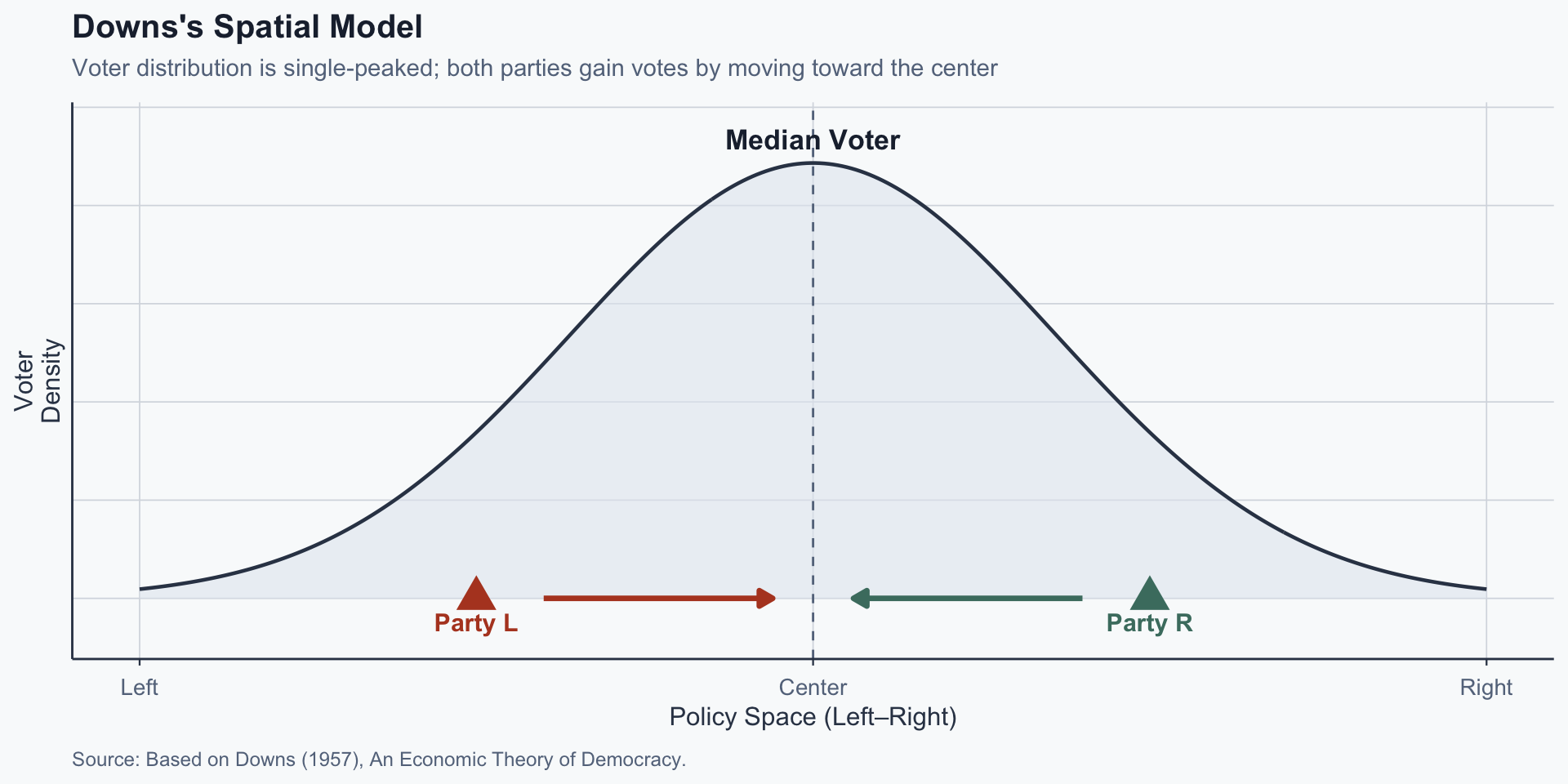
Downs’s Spatial Model

Figure 1: With single-peaked preferences, two office-seeking parties converge to the median voter.

Office vs. Policy: The Core Tension

Two logics of party behavior
Office-Seeking Policy-Seeking
Goal Win elections Implement preferred policy
Strategy Move to median voter Mobilize the base
Prediction Convergence Divergence
Key theorist Downs (1957) Aldrich (1995)

Most real parties combine both — but which dominates shapes party systems.

Key tension: Are parties causes or symptoms of political outcomes?

Exercise 1: Why Parties?

Discussion Exercise (5 min)

Prompt: Think of a democracy where a major party recently collapsed or a new party rapidly emerged (e.g., Italy’s Five Star Movement, France’s En Marche!).

  • Which theory — Aldrich’s collective action or Downs’s spatial model — better explains what happened?
  • Discuss with a partner and prepare a one-sentence answer.

The Cleavage Approach

Lipset & Rokkan: Two Revolutions, Four Cleavages

Lipset & Rokkan (1967): Party systems reflect historical conflicts from two great transformations.

Lipset & Rokkan’s cleavage schema
Cleavage Revolution Conflict Party Examples
Center–Periphery National Language, region SNP, Basque parties
Church–State National Secular vs. religious Christian Democrats
Land–Industry Industrial Agrarian vs. urban Nordic agrarian parties
Capital–Labor Industrial Workers vs. owners Labour, SPD, PS

The Freezing Hypothesis

  • Mass suffrage arrived 1900s–1920s in most of Europe
  • By then, major cleavages were already organized
  • Parties “froze” the cleavage structure
  • Prediction: 1960s party systems mirror 1920s party systems

Empirical implication: If true, party systems should be remarkably stable. Are they?

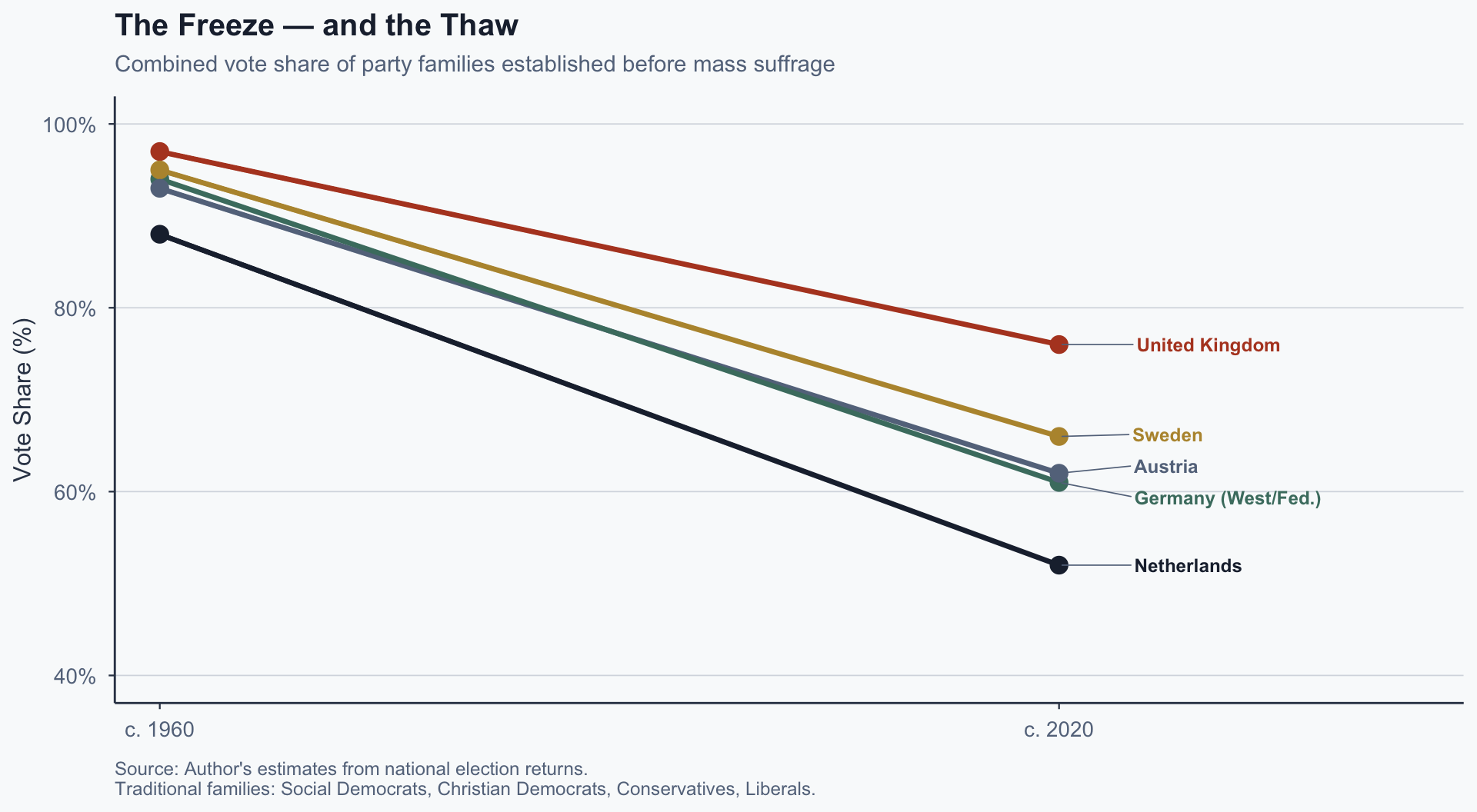
The Freeze — and the Thaw

Figure 2: Combined vote share of traditional party families (Social Democrats, Christian Democrats, Conservatives, Liberals) shows remarkable stability through the 1960s, then gradual erosion.

Where the Thesis Strains: A New Cleavage

  • Post-1960s: new issues cut across old cleavages
    • Environment, immigration, European integration
  • Kitschelt (1994): globalization creates winners and losers along a new axis
  • Kriesi et al. (2008): “demarcation vs. integration” — not just economic, but cultural
  • This new dimension is called GAL–TAN:
    • GAL: Green, Alternative, Libertarian (cosmopolitan, progressive values)
    • TAN: Traditional, Authoritarian, Nationalist (national identity, order)
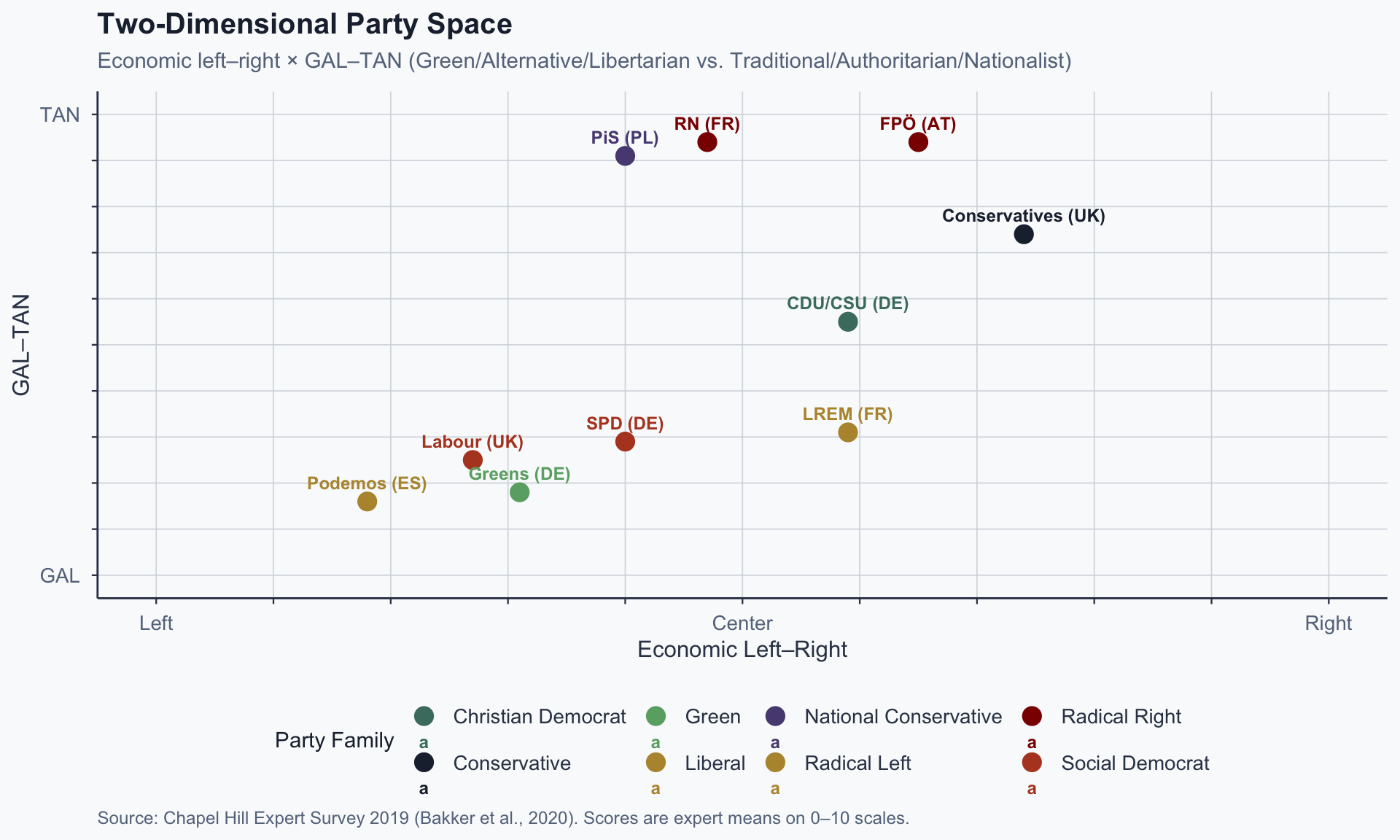
  • A party can be economically left and culturally conservative (PiS) — or economically right and culturally liberal (Macron’s LREM)

GAL–TAN in Practice

Figure 3: European parties on two dimensions, Chapel Hill Expert Survey 2019 (Bakker et al., 2020).

Electoral Systems and Party Systems

Duverger’s Law

  • Single-member districts (SMD) tend to produce two-party systems
  • Proportional representation (PR) tends to produce multiparty systems
  • This works through two effects:
    • Mechanical: how votes are translated into seats
    • Psychological: how voters and elites anticipate the mechanical effect

The Mechanical Effect

  • In SMD: only the plurality winner gets the seat
  • Third parties win votes but very few seats
    • UKIP won 12.6% of UK votes in 2015 → 1 seat
    • Liberal Democrats won 7.9% → 8 seats
  • This mechanically crushes small parties

The seat share is far more concentrated than the vote share.

The Psychological Effect

  • Voters anticipate wasted votes
    • “I prefer the Greens, but I’ll vote Labour to stop the Tories”
  • Elites anticipate futility
    • Donors, activists avoid parties that cannot win
  • Strategic voting reinforces the two-party equilibrium

The psychological effect operates before election day; the mechanical effect operates after.

How Duverger Works

%%{init:{'theme':'base','themeVariables':{'fontSize':'20px','primaryColor':'#4a7c6f','primaryTextColor':'#1e293b','lineColor':'#334155','primaryBorderColor':'#334155'},'flowchart':{'useMaxWidth':true,'nodeSpacing':50,'rankSpacing':60}}}%%
flowchart LR
    A["Electoral<br/>Rule: SMD"] --> B["Mechanical<br/>Effect"]
    A --> C["Psychological<br/>Effect"]
    B --> D["Small parties<br/>win few seats"]
    C --> E["Voters desert<br/>small parties"]
    D --> F["Two-party<br/>system"]
    E --> F

    style A fill:#b44527,stroke:#334155,stroke-width:2px,color:#f9fafb
    style B fill:#f9fafb,stroke:#334155,stroke-width:2px,color:#1e293b
    style C fill:#f9fafb,stroke:#334155,stroke-width:2px,color:#1e293b
    style D fill:#f9fafb,stroke:#334155,stroke-width:2px,color:#1e293b
    style E fill:#f9fafb,stroke:#334155,stroke-width:2px,color:#1e293b
    style F fill:#4a7c6f,stroke:#334155,stroke-width:2px,color:#f9fafb

Cox: Beyond Duverger

  • Duverger gives us a “law” — Cox gives us a mechanism
  • Strategic coordination among voters and elites
  • The “M+1 rule”: in a district of M seats, expect M+1 viable candidates
    • SMD (M=1) → 2 candidates
    • 5-seat PR (M=5) → 6 viable candidates
  • Key insight: institutions interact with social structure

The Endogeneity Problem

Does PR cause multipartyism — or do multiparty societies adopt PR?

  • Many European countries adopted PR because they already had multiple parties
  • Rokkan (1970): PR was a defensive move by old parties facing new competitors
  • The causal arrow is genuinely contested
  • Students should leave knowing this is an open question

Focused Comparison: UK vs. Netherlands

Different rules, different outcomes. Source: Author’s compilation. ENPP = Effective Number of Parliamentary Parties (Laakso & Taagepera, 1979).
United Kingdom Netherlands
Electoral system SMD (FPTP) PR (party list)
Threshold ~30–40% 0.67% (effective)
Parties in parliament 2–3 major 10–15
ENPP (2020s) ~2.4 ~8.5
Strategic voting? Pervasive Minimal

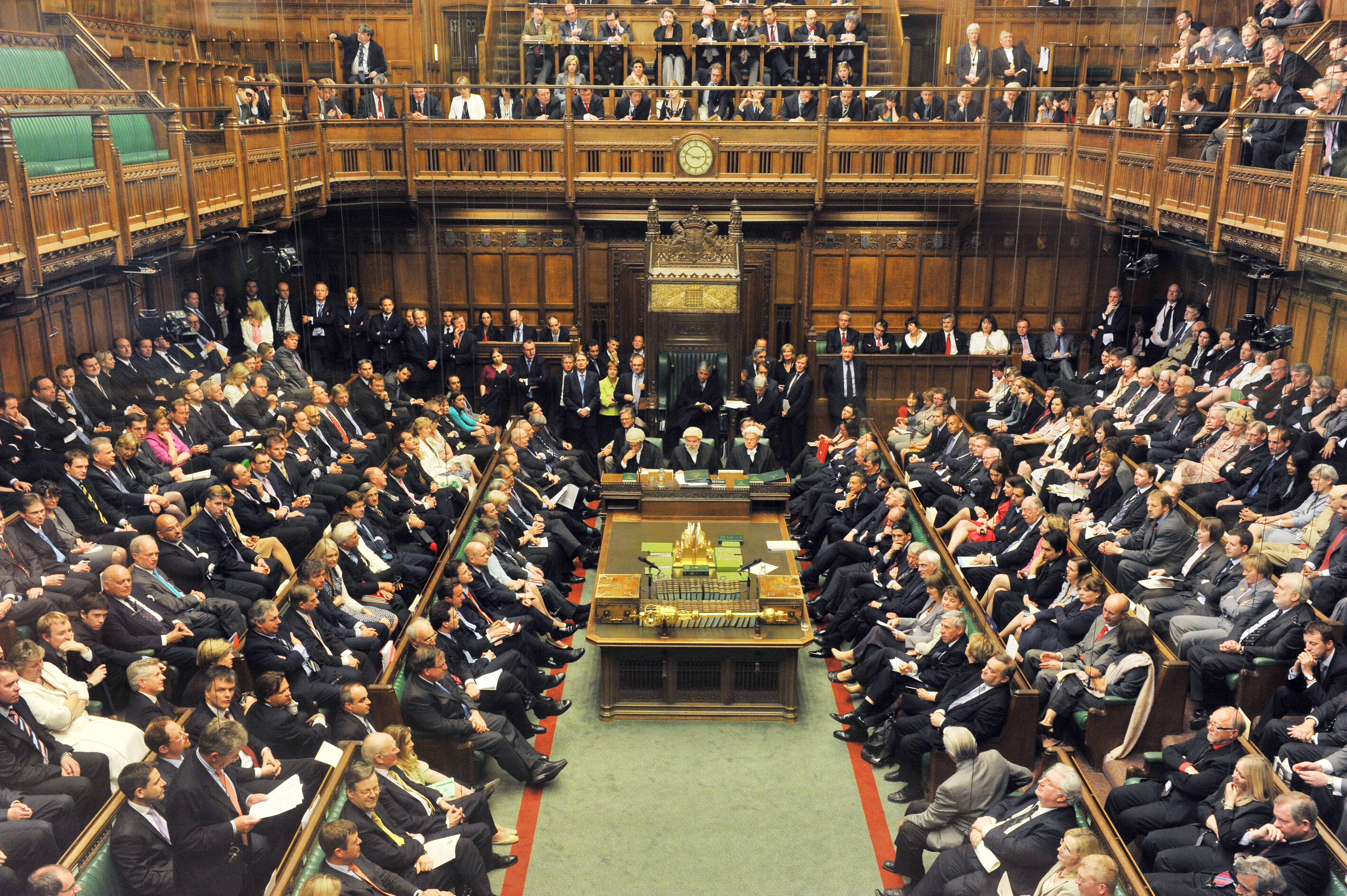
UK House of Commons: adversarial benches

Dutch Tweede Kamer: semicircular layout

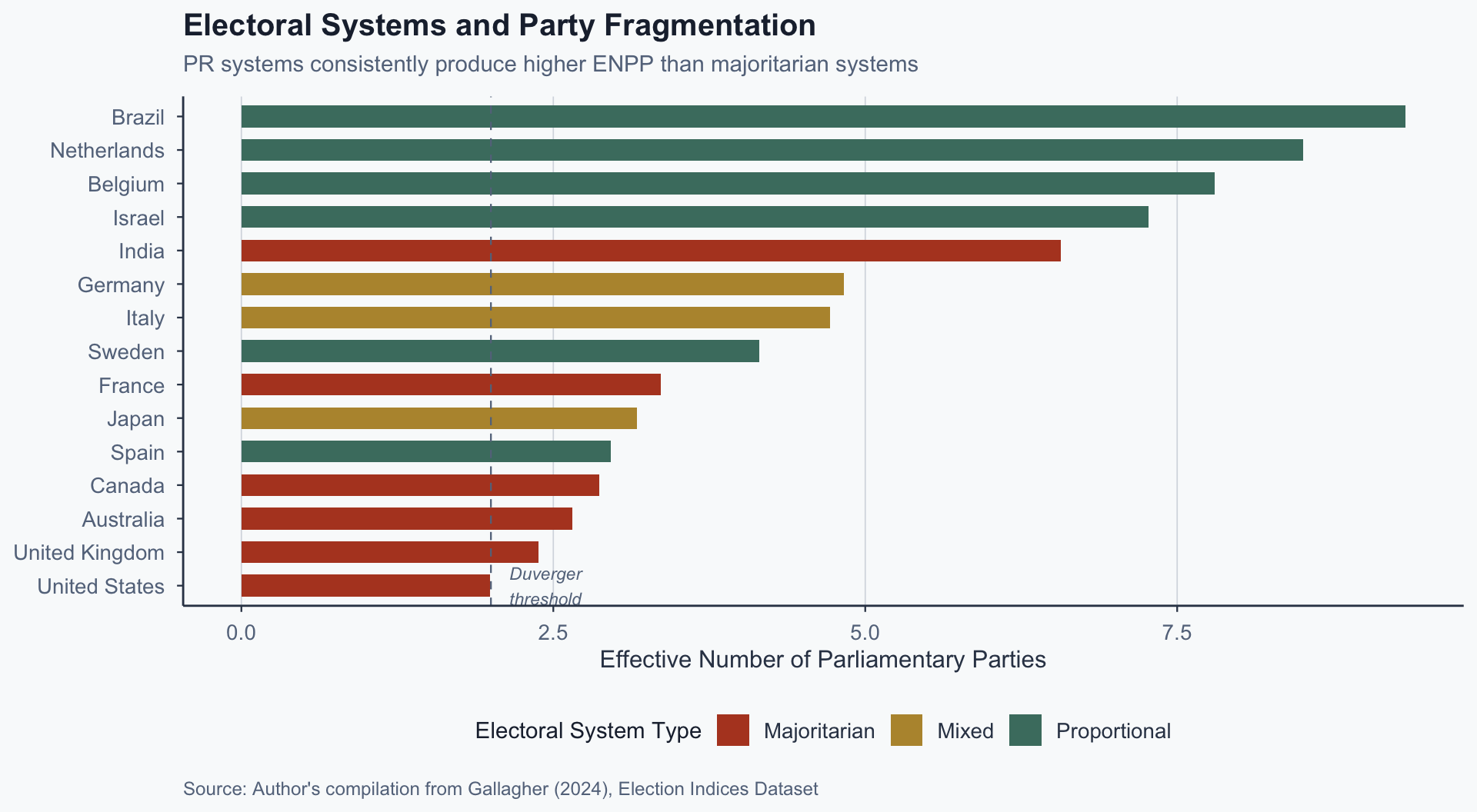
Effective Number of Parties Across Democracies

Figure 4: Effective number of parliamentary parties (ENPP) by electoral system.

Sartori: Beyond Counting Parties

Sartori (1976) — qualitative distinctions that ENPP alone cannot capture
Type ENPP (approx.) Example Key Feature
Predominant ~1.7 Japan (1955–93), Mexico (–2000) One party dominates; others exist but cannot win
Two-party ~2.0 US, UK Two parties alternate in power
Moderate pluralism 3–5 Germany, Sweden Centripetal competition, coalition government
Polarized pluralism 5+ Italy (1st Rep.), Israel Centrifugal, anti-system parties, bilateral opposition

ENPP tells you how many; Sartori (1976) tells you how they interact.

Exercise 2: Duverger in Practice

Discussion Exercise (5 min)

Prompt: India uses single-member districts but has many parties (ENPP ≈ 6.6). Canada uses SMD but regularly has 3–4 major parties.

  • Does this break Duverger’s Law, or can you explain it within the theory?
  • Hint: Think about the difference between national and district-level competition.
  • Discuss with a partner.

Party System Institutionalization

Mainwaring & Scully: Four Dimensions

  • Stability of interparty competition
    • Same parties compete election after election
  • Party roots in society
    • Voters have stable attachments
  • Legitimacy
    • Parties accepted as necessary institutions
  • Organizational coherence
    • Parties are more than personal vehicles

Why Institutionalization Matters

  • Weakly institutionalized systems are vulnerable to:
    • Populist outsiders capturing power
    • Electoral volatility destabilizing governance
    • Democratic backsliding
  • Institutionalized parties serve as gatekeepers
    • They screen out extremists (Levitsky & Ziblatt, 2018)
    • They enforce norms of democratic competition

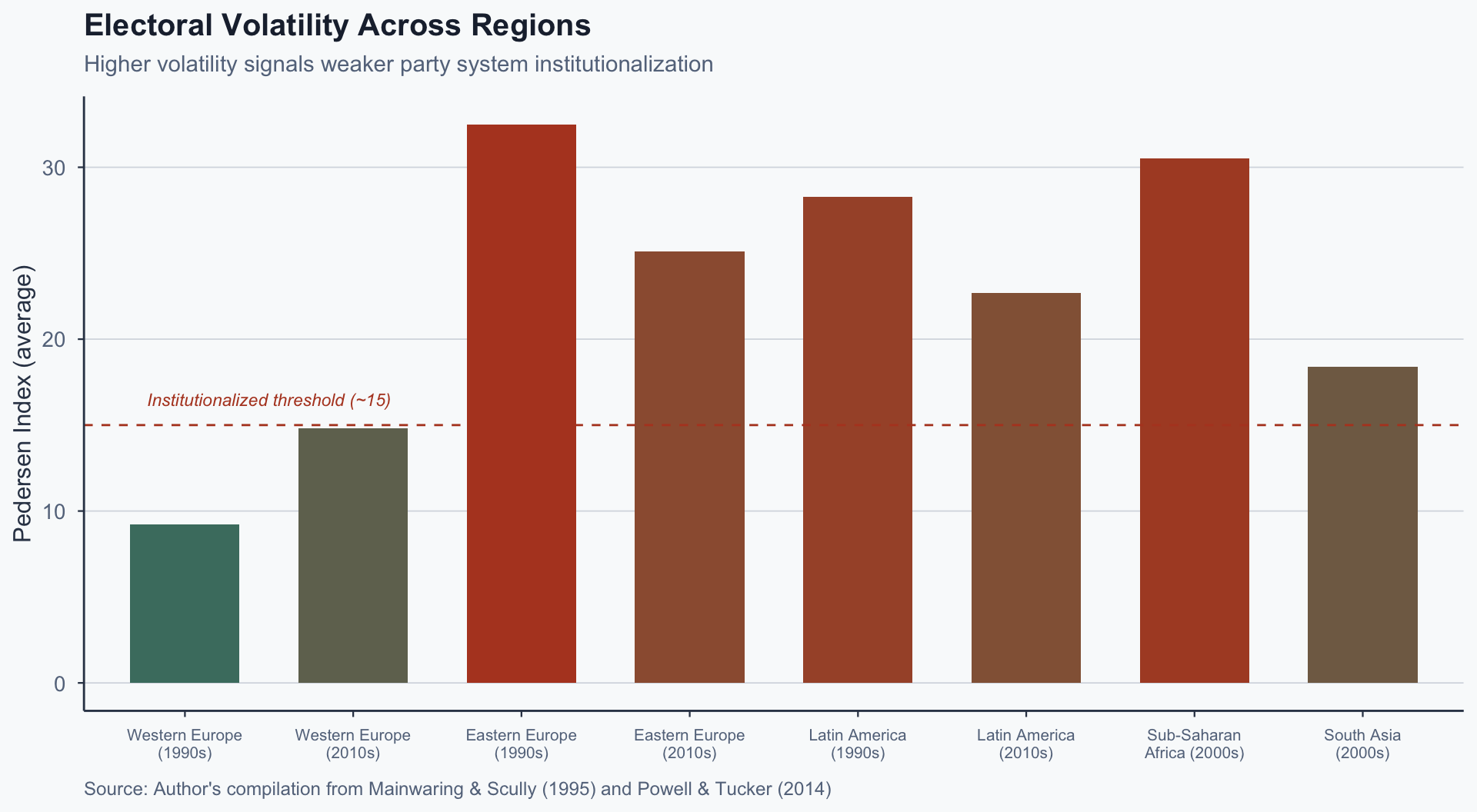
Electoral Volatility Across Regions

Figure 5: Electoral volatility (Pedersen index) by region, 1990s–2010s averages.

Katz & Mair: The Cartel Party

  • Party evolution: cadre (19th c.) → mass (early 20th c.) → catch-all (1960s) → cartel (1990s–)
  • Cartel parties colonized the state: public funding, media access, patronage
  • Traded societal rootedness for state resources
  • The cartel thesis is the missing link: parties became vulnerable because they engineered their own disconnection
  • Outsiders exploit the gap between cartelized elites and disconnected voters

Case: Venezuela

  • Punto Fijo pact (1958–1998): AD + COPEI won ~85% of votes through the 1980s
  • By 1993: combined vote share collapsed to ~46%; by 1998: ~36%
  • Pedersen volatility surged from ~15 to ~55 in a single decade
  • Hugo Chávez (1998): outsider captures presidency
    • Dismantled party system, built personal movement
  • Lesson: institutionalization without societal roots is fragile

Hugo Chávez (2011)

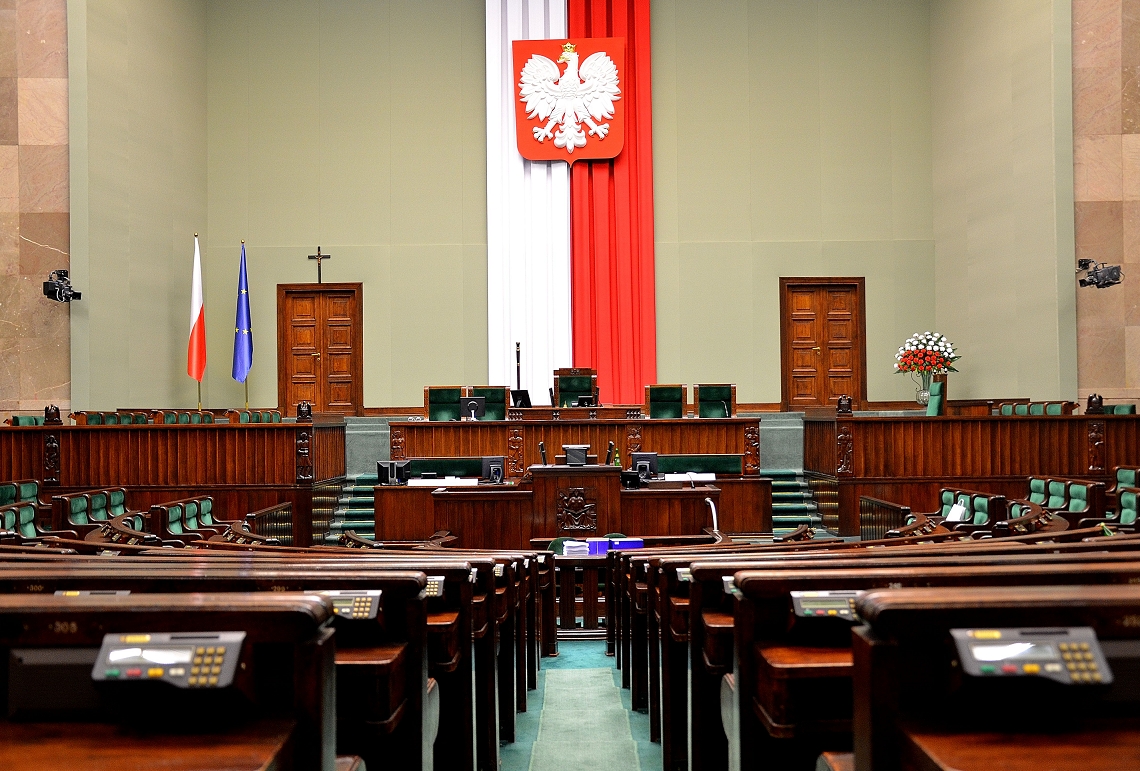
Case: Poland

  • Post-1989: fluid system; Pedersen volatility ~35
  • SLD: 41% of seats (2001) → 11% (2005)
  • PiS: conservative social policy + welfare expansion
  • 37% (2015) → 44% (2019); governed until 2023
  • Outsiders can be organized, not just populist

Polish Sejm chamber

Exercise 3: Gatekeeping

Discussion Exercise (5 min)

Prompt: Levitsky & Ziblatt argue that parties should serve as “gatekeepers” against extremists. Katz & Mair argue that mainstream parties became cartels disconnected from voters.

  • Is there a tension between these two arguments?
  • Can parties be effective gatekeepers and remain connected to voters — or does one inevitably come at the expense of the other?
  • Discuss with a partner.

Synthesis

Three Frameworks Compared

Each answers a different question about the same phenomenon
Framework Key Question Unit of Analysis Prediction
Cleavage theory Which conflicts exist? Social structure Stability
Duverger/Cox How many parties survive? Electoral rules Format
Institutionalization How strong are parties? Organizations Quality of democracy

No single framework is sufficient. The best analysis combines all three.

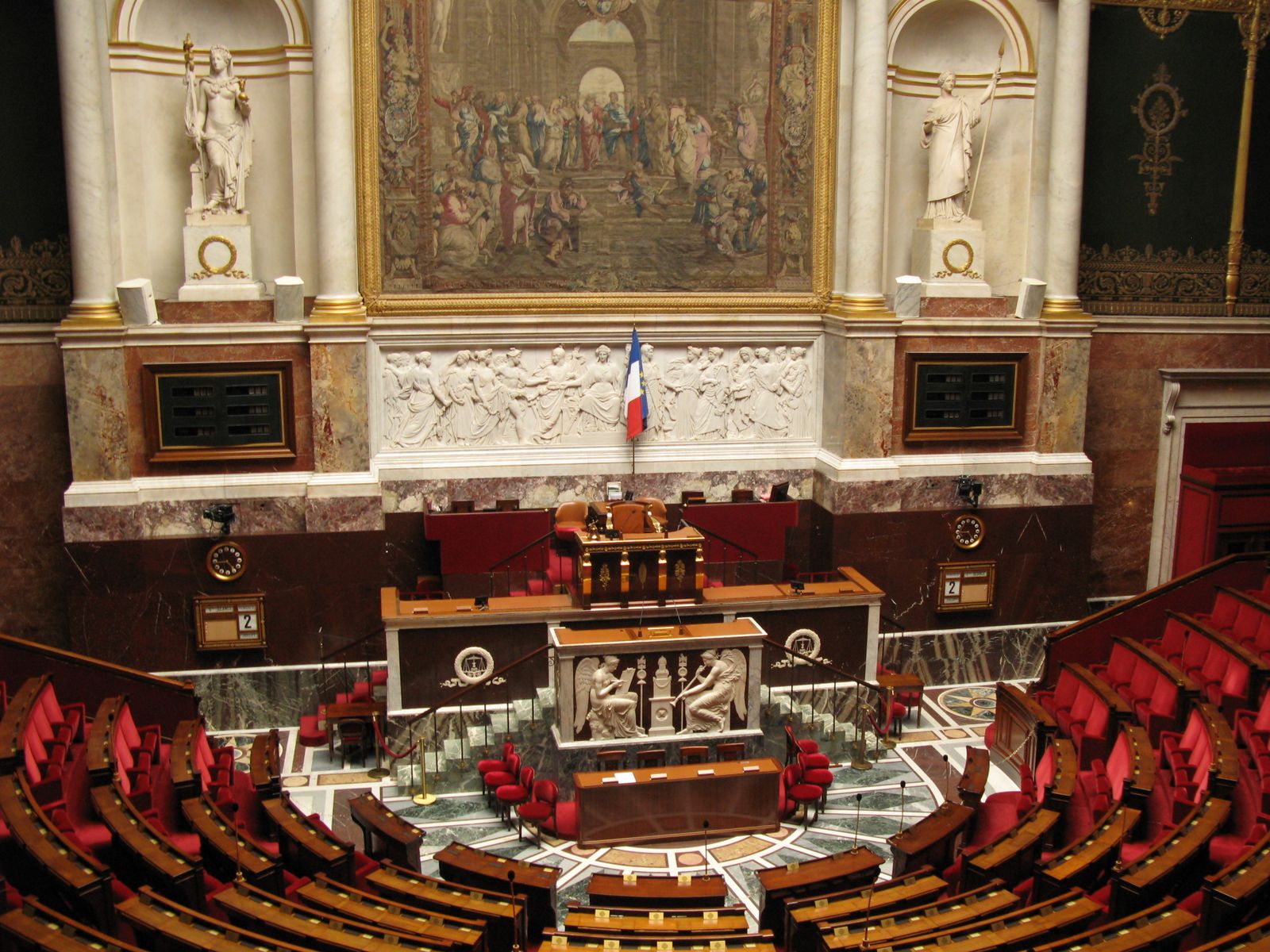
The Hard Case: France

  • Cleavage theory: Left–Right frozen since Revolution? But post-materialist cleavages cut across
  • Duverger: Two-round system → moderate multipartyism? But Macron shattered the duopoly in 2017
  • Institutionalization: PS and LR had deep roots — yet collapsed in a single cycle
  • Why? Cartelized parties + new GAL–TAN cleavage + two-round system enabling outsider coordination
  • All three frameworks are necessary — and insufficient alone

French National Assembly

Key Takeaways

  • Parties solve collective action problems for voters and legislators
  • Cleavages determine which conflicts parties organize
  • Electoral rules constrain how many parties survive
  • Institutionalization determines how stable the system is
  • The cartel thesis explains why even institutionalized systems erode
  • No single framework suffices — comparative analysis requires all three

References I

Aldrich, J. H. (1995). Why parties? The origin and transformation of political parties in America. University of Chicago Press.

Bakker, R., Hooghe, L., Jolly, S., Marks, G., Polk, J., Rovny, J., Steenbergen, M., & Vachudova, M. A. (2020). 2019 Chapel Hill Expert Survey. Version 2019.3. Chapel Hill, NC: University of North Carolina.

Boix, C. (1999). Setting the rules of the game: The choice of electoral systems in advanced democracies. American Political Science Review, 93(3), 609–624.

Cox, G. W. (1997). Making votes count: Strategic coordination in the world’s electoral systems. Cambridge University Press.

Downs, A. (1957). An economic theory of democracy. Harper & Row.

Duverger, M. (1954). Political parties: Their organization and activity in the modern state. Wiley.

Gallagher, M. (2024). Election indices dataset. Trinity College Dublin. Retrieved from https://www.tcd.ie/Political_Science/people/michael_gallagher/ElSystems/

References II

Katz, R. S., & Mair, P. (1995). Changing models of party organization and party democracy: The emergence of the cartel party. Party Politics, 1(1), 5–28.

Kitschelt, H. (1994). The transformation of European social democracy. Cambridge University Press.

Kriesi, H., Grande, E., Lachat, R., Dolezal, M., Bornschier, S., & Frey, T. (2008). West European politics in the age of globalization. Cambridge University Press.

Laakso, M., & Taagepera, R. (1979). “Effective” number of parties: A measure with application to West Europe. Comparative Political Studies, 12(1), 3–27.

Levitsky, S., & Ziblatt, D. (2018). How democracies die. Crown.

Lipset, S. M., & Rokkan, S. (1967). Cleavage structures, party systems, and voter alignments: An introduction. In S. M. Lipset & S. Rokkan (Eds.), Party systems and voter alignments (pp. 1–64). Free Press.

Mainwaring, S., & Scully, T. R. (Eds.). (1995). Building democratic institutions: Party systems in Latin America. Stanford University Press.

Morgan, J. (2011). Bankrupt representation and party system collapse. Penn State University Press.

Powell, E. N., & Tucker, J. A. (2014). Revisiting electoral volatility in post-communist countries: New data, new results and new approaches. British Journal of Political Science, 44(1), 123–147.

References III

Rokkan, S. (1970). Citizens, elections, parties. Universitetsforlaget.

Sartori, G. (1976). Parties and party systems: A framework for analysis. Cambridge University Press.

Schattschneider, E. E. (1942). Party government. Holt, Rinehart and Winston.

Stanley, B. (2016). Populism in Central and Eastern Europe. In C. Rovira Kaltwasser, P. Taggart, P. Ochoa Espejo, & P. Ostiguy (Eds.), The Oxford handbook of populism (pp. 140–160). Oxford University Press.